



October is Tyre Safety Month: Why UK Drivers Should Pay Attention
The traffic ahead brakes suddenly. You lift off the accelerator, press the brake pedal and expect your car to stop safely. Most days, that expectation is never seriously tested. On a wet road, however, the distance available can disappear surprisingly quickly.
That is why Tyre Safety Month matters. This October, TyreSafe is asking motorists to consider whether the confidence they feel behind the wheel is matched by the condition of their tyres.
Its 2026 campaign, Act Before You REact, focuses on preparing for those unexpected moments. You cannot predict every hazard but you can make sure your tyres are ready before one appears.
Why October is Tyre Safety Month
TyreSafe was established in 2006 to raise awareness of tyre maintenance and reduce incidents involving defective or illegal tyres. Its annual October campaign brings that message to motorists through road safety organisations, garages and other supporters.
By October, many familiar journeys involve darker evenings, rain and wet road surfaces. Checking your tyres now helps you spot wear or damage before you need to brake sharply on a rain-soaked commute.
Tyre safety remains relevant because deterioration is easy to overlook. A car may still feel familiar on the school run even when its pressures are incorrect or its tread is wearing unevenly. Everyday driving does not necessarily reveal how it will behave during emergency braking.
The Highway Code states that stopping distances in wet weather will be at least double those required on dry roads. Allowing more space is essential, alongside keeping your tyres properly maintained.
The 2026 Campaign: Act Before You REact
TyreSafe’s latest research highlights a striking gap between confidence and understanding:
- 83% of drivers believe they are in full control of their vehicle’s stopping distance. (TyreSafe)
- Only 6% correctly identified how much additional stopping distance is needed in wet conditions at motorway speeds. (TyreSafe)
Those findings suggest that feeling capable does not always mean recognising the limits of the vehicle beneath you.
Imagine a familiar motorway journey in heavy rain. You know the route, your brakes seem responsive and the car has given you no obvious reason for concern. Yet the road conditions have changed, and the space you normally leave may no longer be enough.
Tyres are part of that equation. Your reactions determine when braking begins, but the available grip helps determine what happens afterwards.
The Tyre Safety Month 2026 campaign also reports that 38% experienced a near miss in the previous 12 months, while only 11% checked their tyres afterwards.
A near miss does not prove that tyres were responsible. Another driver may have pulled out or traffic may have stopped unexpectedly. Nevertheless, it offers a useful opportunity to consider whether your own vehicle needs attention.
Once the immediate scare passes, it is easy to carry on. Checking the car afterwards turns that experience into something practical, particularly if you noticed slipping, vibration or unfamiliar handling.
Three Simple Tyre Checks That Make a Difference
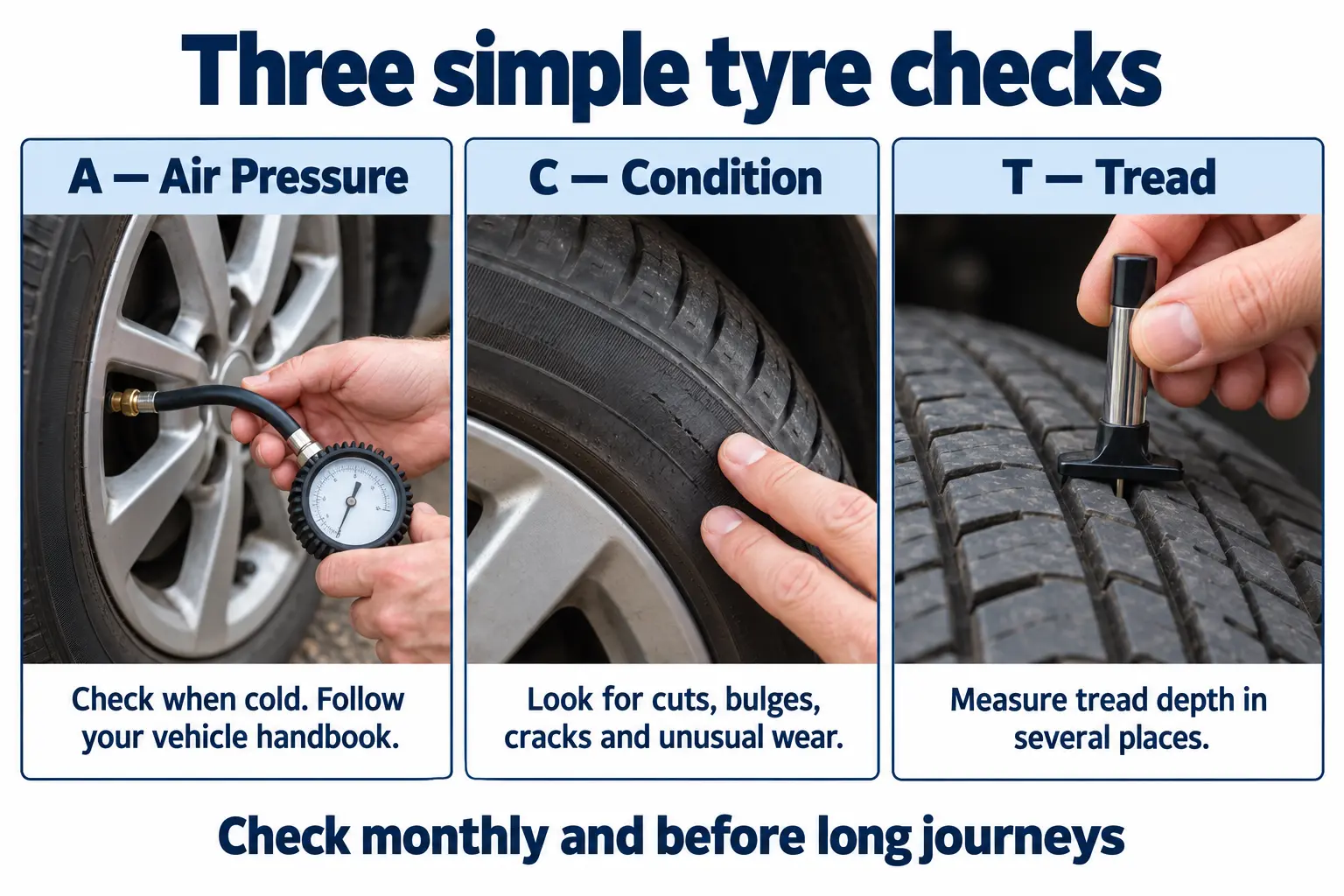
TyreSafe’s ACT reminder stands for Air Pressure, Condition and Tread. The campaign encourages these checks every month and before long journeys.
A – Air Pressure
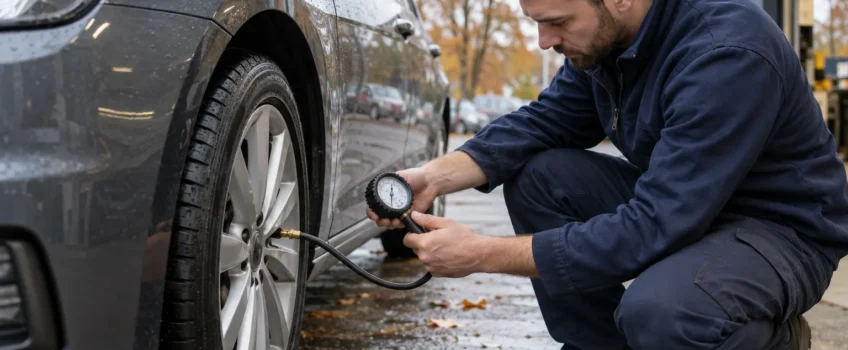
Correct inflation supports handling, braking performance and even wear. Check pressures with an accurate gauge when the tyres are cold, using the vehicle manufacturer’s recommended figures.
These are usually found in the handbook, inside the driver’s door area or near the fuel filler flap. Check whether different pressures are specified when carrying passengers and luggage. The figure on the tyre sidewall is not your normal operating pressure.
C – Condition
Look for cuts, cracks, bulges, embedded objects and unusual wear. Check the visible sidewalls as well as the tread; having plenty of tread does not rule out other damage.
If you find a bulge or significant damage, seek professional advice before driving further. An inspection is also sensible after a substantial pothole impact or when the car begins to feel different.
T – Tread
Tread grooves help disperse water and maintain contact with the road. For cars, the legal minimum is 1.6mm across the central three-quarters of the tread’s width and around the entire circumference.
Use a tread-depth gauge and check several positions rather than relying on one measurement. The legal minimum is a limit, so do not assume a tyre just above it performs like a new one in wet weather.
What Previous Tyre Advice Tells Us
Several subjects covered in earlier Elite Garages articles help put this year’s campaign into everyday context.
Changes in noise deserve attention. A different road surface can make healthy tyres sound louder. However, persistent humming or droning across different roads can accompany uneven wear or other issues. Our guide to why tyres suddenly become noisier explains what those changes may tell you.
Wear patterns can reveal more than remaining tread depth. One edge wearing faster than another may point to pressures, alignment or another mechanical issue. Understanding uneven tyre wear and when alignment needs checking can help you recognise a problem before another set wears prematurely.
Replacement choices deserve more than a price comparison. Budget, mid-range and premium options need to be considered alongside your vehicle, mileage and driving conditions. Our guide to choosing budget tyres and comparing the alternatives explores those decisions. Whatever you choose, continued maintenance matters.
Together, these lessons encourage a useful habit: notice changes, investigate them and make informed decisions before a problem becomes urgent.
How Elite Garages Helps Motorists Stay Safe
If you are unsure about tyre condition or replacement options, Elite Garages can provide practical advice based on your vehicle, budget and driving requirements.
Its range includes budget, mid-range and premium tyres, with brands such as Michelin, Continental, Bridgestone, Goodyear and Pirelli. Suitable choices depend on the tyre size and specification your vehicle requires, as well as availability.
Elite’s membership of Group Tyre supports access to a substantial tyre supply network. Your local team can help identify suitable replacements and confirm stock and fitting arrangements.
Elite Garages’ growing presence across the South West and Gloucestershire means more drivers can turn to a local team for tyre advice and free tyre safety checks. Whether you have recently noticed a change in how your car feels or simply want reassurance before autumn journeys, contact your nearest branch to arrange a check and discuss any concerns.
Book a Free Tyre Safety Check
You do not need to wait for a warning light, an obvious puncture or a frightening moment in traffic to give your tyres some attention.
Elite Garages offers free tyre checks across its branches. If you are unsure about tread depth, have spotted uneven wear or keep needing to top up a tyre, the team can inspect it and explain whether further attention is needed.
Contact your local branch during opening hours or use the booking request option described on the Free Checks page. The team will confirm your appointment.
FAQS
Click the + to read any answer or visit our most FAQ page to review the most frequently asked questions across all our Elite Locations.
If you click on a ‘Category’ or ‘Tag’ link, the page will ‘refresh’ and reload the page showing the top of the page first, you’ll then just need to scroll down to the FAQ section to see the results for the Category or Tag you selected.
At Elite Garages, we always try to get your car booked in as soon as possible and our booking system helps. Call your local garage within normal business hours or request a service slot online if after hours.
Some customers will have a bronze car service one year and a silver car service the next so if they’re not doing the mileage, it’s not always advised to book a silver car service every year. Most of our customers book an MOT and service at the same time.
We offer bronze car service (standard) and silver car service (premium) at affordable, competitive rates – see the home page for our current Car Service prices.
Categories:
Car Servicing
Caterham
Haywards Heath
Horsham
Premium Service
Southampton
Standard Service
We always explain this in detail, providing a list of what’s included and what is not. If a customer asks what service they need, we can advise depending on the service schedule and the manufacturer’s specification. Click here for more information.
At the time of posting, the price of a bronze car service (standard service) is from £110 and a silver car service (premium service) from £210. The service time will depend on what is being done and if any problems are identified which may require additional work.
We will discuss the customer’s vehicle and what extras it may need and then provide them with a quote specific to their requirements. Typically, a bronze service starts from £110, and a silver service from £210 but prices do vary depending on the vehicle.
Categories:
Car Servicing
Electric Vehicle Servicing
As with internal combustion engine cars, an electric car service interval also depends on manufacturer recommendations so it’s important to check your owner’s manual for accurate details. For the most part, an electric car service schedule is similar to that of petrol or diesel cars.
A car service interval will largely depend on the car and the service schedule from the manufacturer. The common interval is 12,000 miles or 12 months, but you still have to check your car’s service book to verify.
Categories:
Bournemouth
Car Servicing
We get them in and out as quickly as possible. We have a good booking system where we can work out our day so we’re not overlapping appointments too much. We do our best so people aren’t waiting too long.
At Elite Garages Bournemouth we always try to get the customer’s car booked in as soon as possible and our booking system helps. Call your local garage here or outside of normal business hours where you can request a slot and we’ll be in touch the next working day to confirm it.


