




What Are the Most Common Reasons for a Car Losing Power?
Most drivers will agree that a car losing power, whether suddenly or over time, can be a worrying experience especially when you’re not sure what’s causing it.
If your car is losing power while driving, it’s not something to ignore. In some cases, it’s a minor issue. In others, it’s your car’s way of warning you that something more serious is developing under the bonnet.
The key is understanding what’s actually happening, and knowing when to act.
1. Blocked or Dirty Fuel System
One of the most common reasons for a car losing power is restricted fuel supply. Your engine relies on a precise mix of fuel and air. If fuel isn’t reaching the engine efficiently, performance drops almost immediately.
Common causes may include:
- clogged fuel filters
- dirty or partially blocked fuel injectors
- contaminated fuel
Over time, debris and residue can build up inside the fuel system, especially if the car is used for short journeys or left sitting for long periods.
What makes this interesting:
Modern engines are far more sensitive than older ones. Even slight restrictions can trigger noticeable power loss—especially during acceleration or uphill driving.
If left unresolved, this can also lead to poor fuel economy and increased emissions, which may impact your MOT results.
2. Turbocharger Problems (If Your Car Has One)
If your car has a turbo (and most modern petrol and diesel cars do), it plays a huge role in delivering power.
A failing or underperforming turbo can cause:
- delayed acceleration
- reduced pulling power
- a “flat” driving feel
Why this happens:
Turbochargers rely on air pressure and precise airflow. Any issue—whether it’s a leak, worn components, or carbon build-up—can reduce their effectiveness.
What many drivers don’t realise:
A faulty turbo doesn’t always fail dramatically. It often degrades gradually, meaning you may not notice the drop in performance straight away.
3. Airflow Issues (Air Filter or MAF Sensor)
Your engine needs clean, measured airflow to perform properly. If that airflow is disrupted, your car can feel noticeably weaker.
Two main culprits:
Air filter
- becomes clogged with dirt and debris
- restricts airflow into the engine
Mass Air Flow (MAF) sensor
- measures how much air enters the engine
- sends incorrect data if dirty or faulty
Why this matters:
Even small airflow miscalculations can throw off the fuel-air ratio, reducing engine efficiency and power. This is one of the most overlooked causes of power loss—and one of the easiest to fix during routine servicing.
Regular maintenance at a professional garage like Elite Garages helps catch these issues early. Find out more about our car servicing options.
4. Ignition Problems (Petrol Engines)
If you drive a petrol car, the ignition system is critical for performance.
Common issues:
- worn spark plugs
- faulty ignition coils
- inconsistent spark timing
When the ignition system isn’t working properly, fuel isn’t burned efficiently. That leads to:
- reduced power
- engine misfires
- rough acceleration
Something many drivers miss:
Spark plugs don’t fail instantly, they wear gradually. So a car losing power can happen slowly, which makes it harder to notice until it becomes obvious.
5. Electrical or Sensor Faults (Modern Cars & EVs)
Modern vehicles, especially hybrids and EVs, rely heavily on sensors and electronics.
If your car is losing power while driving, it could be due to:
- faulty sensors
- software-related issues
- control module errors
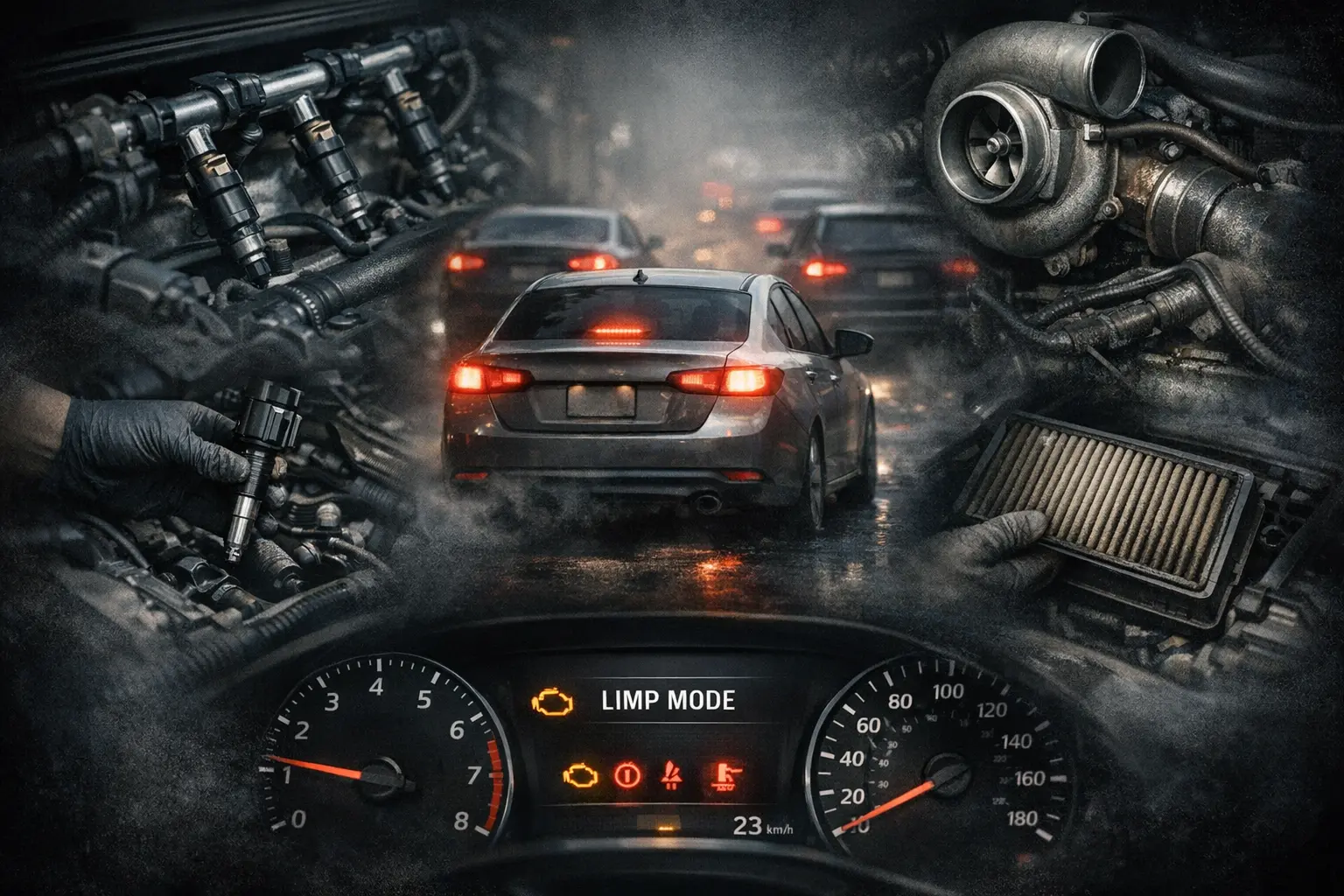
In some cases, the car may enter a “limp mode”, intentionally reducing power to protect the engine or drivetrain.
Why this is increasingly common:
According to the Society of Motor Manufacturers and Traders, the UK car market continues to shift toward electrified and highly digital vehicles, meaning more performance issues are now software or sensor-related rather than purely mechanical. For EV and hybrid drivers, this becomes even more relevant.
What is Limp Mode in a car?
Limp mode (sometimes called “limp home mode”) is a built-in safety feature in modern vehicles that activates when a serious fault is detected. It reduces engine power, limits revs and restricts speed to help prevent further damage, allowing you to drive cautiously to a garage for inspection.
Is It Safe to Drive If Your Car Is Losing Power?
It depends on the cause, but in many cases, no.
Loss of power can:
- make overtaking dangerous
- reduce your ability to respond quickly in traffic
- indicate deeper mechanical issues
If the problem worsens suddenly or is accompanied by warning lights, it’s best to stop driving and get the vehicle checked.
How Elite Garages Diagnoses a Car Losing Power
Power loss isn’t a single fault, it’s a symptom. That’s why proper diagnosis matters.
At Elite Garages, our technicians use advanced diagnostic tools, real-time data analysis and practical mechanical inspections to identify the root cause quickly and accurately. They will provide you with a detailed report with recommended repairs and a no-obligation quote. Here’s some valuable insight into how diagnostics and servicing work in modern vehicles.
A Surprising Insight: Power Loss Isn’t Always Engine-Related
One lesser-known factor is rolling resistance from tyres. Worn, underinflated, or unsuitable tyres can:
- make acceleration feel slower
- reduce efficiency
- increase strain on the engine
Tyre condition and pressure can influence how a car feels on the road. TyreSafe notes that incorrect pressures can reduce vehicle control, increase stopping distances and raise fuel consumption.
This is why a full vehicle check, not just engine diagnostics, is essential.
When Should You Get It Checked?
You should book an inspection if:
- the issue happens repeatedly
- acceleration feels noticeably weaker
- warning lights appear
- fuel consumption increases unexpectedly
Catching the issue early can prevent:
- more expensive repairs
- breakdowns
- failed MOT tests
Final Thoughts: Reasons For My Car Losing Power?
If your car is losing power while driving, it’s rarely “just one of those things.” It’s usually your vehicle telling you something needs attention, whether that’s airflow, fuel delivery, ignition, or modern electronic systems.
The important thing is not to guess.
A proper diagnosis can turn a confusing symptom into a clear, fixable issue and often quicker, more cost-effective than you might expect. And with modern vehicles becoming more complex, having experienced technicians who understand both traditional mechanics and newer systems is more important than ever.
If something doesn’t feel right, trust that instinct. A car losing power is almost always worth checking.
FAQS:
Click the + to read any answer or visit our most FAQ page to review the most frequently asked questions across all our Elite Locations.
Category:
Car Losing Power
Driving a car that is losing power is not always safe and depends on how severe the issue is. Reduced engine performance can limit acceleration, make overtaking difficult, and affect how the car responds in traffic.
If the vehicle enters limp mode, it may still be drivable at low speeds for a short distance, but this is designed to protect the engine rather than allow normal use.
If the problem is persistent, worsening, or accompanied by warning lights, it is advisable to avoid driving the vehicle and have it inspected as soon as possible to prevent further damage or safety risks
Category:
Car Losing Power
A car losing power while driving is usually caused by an issue with fuel delivery, airflow, ignition, or electronic control systems. Common causes include a clogged fuel filter, restricted air intake, faulty sensors such as the mass air flow (MAF) sensor, or problems with the turbocharger.
In modern vehicles, power loss can also occur when the car enters a protective “limp mode”, reducing engine performance to prevent further damage. This is often triggered by abnormal readings from engine or emissions systems.
Because several systems can cause the same symptom, identifying the exact reason a car is losing power typically requires proper diagnostic checks rather than guesswork
Category:
Car Losing Power
Diagnosing a car losing power involves identifying whether the issue is related to fuel supply, airflow, ignition, or electronic systems. Technicians typically begin with a diagnostic scan to check for fault codes stored in the vehicle’s control systems.
From there, they may inspect key components such as the air filter, fuel filter, spark plugs, sensors, and turbo system, depending on the type of engine.
Because modern vehicles rely on interconnected systems, accurate diagnosis often requires both digital diagnostics and physical inspection. This helps ensure the root cause is identified correctly, rather than replacing parts unnecessarily.


