



Short Winter Journeys: The Damaging Driving Habit Nobody Talks About
Short winter journeys feel harmless. They’re local, familiar, and low mileage. For many drivers, especially during colder months, they make up almost every trip. Think: school runs, quick errands, short commutes, or a 5-minute drive to the shops.
Because the distances are so small, it’s easy to assume the car isn’t working very hard. In reality, repeated short journeys are one of the most damaging driving habits for modern cars, and winter conditions quietly magnify their effects.
The issue isn’t how far the car travels. It’s how often it’s started, how rarely it fully warms up, and how long key systems are forced to operate below their intended temperature.
Short journeys are rarely discussed as a risk factor, yet they sit alongside other everyday habits that secretly place strain on vehicles, like excessive idling or repeated cold starts. These are explored further in our guide to driving habits that could damage your car.
Understanding this driving pattern explains why so many car problems in winter appear suddenly, even when mileage is low and nothing obvious has changed.
Why Short Journeys Are Hard on Cars All Year, Not Just in Winter
Cars are made to run at a stable operating temperature. Engines, batteries, exhaust systems, and emissions controls are all designed to perform efficiently once fully warmed up. Short journeys interrupt that process.
When a car is started from cold:
- Engine oil is thicker and circulates less efficiently
- Internal components experience higher friction
- Electrical systems draw heavily from the battery
- Fuel mixtures are richer to keep the engine running
On a longer drive, these effects are temporary. On repeated short trips, they become the norm.
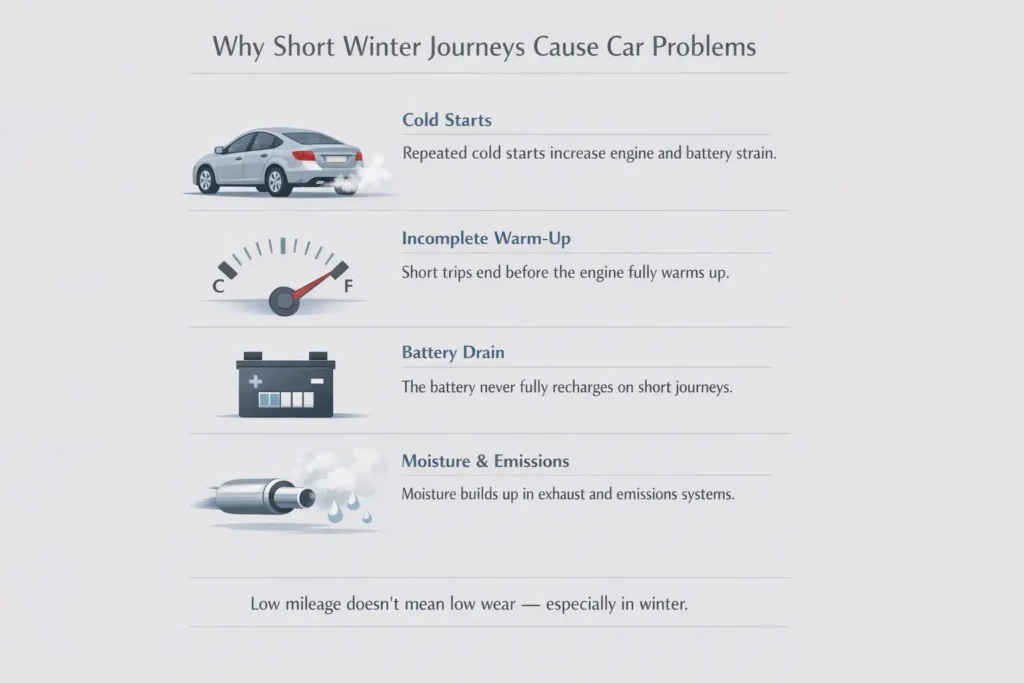
Short journeys place disproportionate strain on vehicles because engines and emissions systems are repeatedly operated below their optimal temperature. This increases wear, prevents moisture from evaporating, and accelerates deterioration even when overall mileage is low.
Winter doesn’t create this problem, it simply reduces the margin for error.
Why Short Winter Journeys Are More Damaging
Cold weather slows everything down. Batteries deliver less usable power, oil takes longer to thin, and engines need more time to stabilise.
On short journeys in winter, the car may be switched off before it has properly recovered from starting. That means:
- The battery gives energy but doesn’t get it back
- Moisture created during combustion remains trapped
- Exhaust components stay cool and damp
- Emissions systems never complete their cycles
While winter conditions can expose weaknesses across many vehicles, this article focuses on the underlying causes, especially shorter journeys, in contrast to the broader seasonal effects explored in why car problems happen more often in January.
Car Battery Problems Caused by Short Winter Journeys
Battery issues are one of the most common car problems in winter, and short journeys play a central role.
Starting a car requires a large burst of energy. In winter, electrical demand increases immediately as the lights, heaters, demisters, and wipers all draw power. On a longer drive, the alternator has time to recharge the battery. On a short trip, it often doesn’t.
Cold temperatures also reduce a battery’s usable capacity.
Short winter journeys create an imbalance between battery discharge and recharge. Cold temperatures reduce battery efficiency, while repeated cold starts and increased electrical demand prevent full recovery, leading to battery failure even at low mileage.
This is why car battery problems in winter are so common among drivers who “barely drive”.
Because this decline happens gradually, it’s often missed until failure occurs. Understanding how batteries degrade, and how to test them properly, is covered in detail in this guide on car battery maintenance and expert garage services.
Where symptoms such as slow starting or intermittent warning lights appear, booking a battery service or health check helps identify problems before winter failure occurs.
Low Mileage Doesn’t Protect Against Car Problems — It Can Make Them Worse
Many drivers associate wear with distance. In reality, how a car is used matters more than how far it travels. Low-mileage cars that only do short trips often experience:
- Corrosion inside exhaust systems
- Brake components that bind or seize
- Seals that dry out or stiffen
- Sensors exposed to repeated condensation
Without sustained heat cycles, moisture doesn’t burn off and components don’t operate as intended. Over time, this leads to the same, or greater, level of degradation as higher-mileage driving. This explains why persistent car problems at low mileage often affect vehicles that are used gently but infrequently.
Exhaust and Emissions Problems Linked to Short Journeys
Modern exhaust and emissions systems rely on heat.
During short journeys, moisture produced during combustion remains inside the exhaust rather than evaporating. Over time, this contributes to corrosion of silencers and back boxes.
For diesel vehicles, the impact can be more pronounced. Diesel Particulate Filters (DPFs) require sustained higher temperatures to regenerate and burn off soot. Repeated short trips, especially in winter, may never allow this process to complete.
Short winter trips prevent exhaust and emissions systems from reaching the temperatures required to function correctly, leading to condensation build-up, corrosion, and incomplete DPF regeneration.
This is why DPF problems caused by short journeys often appear suddenly, even when the car seems otherwise well maintained. If you’re concerned about your exhaust system, visit any of our Elite Garages branches for advice and a free check.
“Nothing Has Changed”, So Why Do Problems Appear Without Warning?
One of the most frustrating aspects of short-journey damage is how quietly it develops.
Faults rarely appear overnight. Instead, marginal components slowly degrade until colder weather, lower battery output, or increased moisture pushes them past tolerance.
Winter doesn’t introduce new faults, it reveals the effects of accumulated stress.
While many issues linked to short winter journeys begin as minor inefficiencies, some develop into serious and expensive faults if left unresolved. Problems affecting braking, steering, or emissions systems often escalate quietly, as outlined in expensive car problems that could spell trouble.
Which Drivers Are Most Affected by Short Winter Journeys?
Certain driving patterns are more likely to cause problems, particularly in winter:
- School-run and town drivers
- Remote or hybrid workers
- Second-car owners
- Retired drivers using cars infrequently
- Vehicles used mainly for errands and short commutes
These drivers aren’t abusing their cars. Their vehicles are simply being used in a way that modern systems struggle with — especially in cold conditions.
What Actually Helps Reduce the Impact of Short Winter Journeys?
Reducing damage doesn’t require drastic changes, just awareness. Things that help include the following:
- Occasional longer drives that allow full warm-up
- Servicing based on usage patterns, not mileage alone
- Early investigation of warning lights or repeated symptoms
- Battery health checks before failure occurs
For drivers who rely on short journeys, having a vehicle checked based on how it’s used rather than mileage alone can help prevent winter-related issues from compounding. Booking a car service or free vehicle check allows potential problems to be identified early, before they escalate.
Why Awareness Matters More Than the Season
Short trips are not “wrong”. For many people, they’re unavoidable. The issue is not winter itself but how winter amplifies an already damaging habit.
Government-backed road safety guidance from Think! reinforces the importance of understanding how everyday driving habits affect vehicle safety and reliability. Regular checks and awareness of usage patterns help reduce the risk of preventable faults, particularly during colder months when short journeys place additional strain on vehicles.
When drivers understand the relationship between short trips, cold starts, and incomplete operation, many winter car problems become predictable rather than frustrating. That understanding is often the difference between minor maintenance and unnecessary repairs.
FAQS: Car Trouble and Short Winter Journeys
Click the + to read any answer or visit our most FAQ page to review the most frequently asked questions across all our Elite Locations.
If you click on a ‘Category’ or ‘Tag’ link, the page will ‘refresh’ and reload the page showing the top of the page first, you’ll then just need to scroll down to the FAQ section to see the results for the Category or Tag you selected.
Category:
Short Journeys
Drivers who mainly do short winter trips can reduce problems by:
- Taking occasional longer drives to fully warm the engine
- Keeping the battery in good health through regular checks
- Ensuring tyres, coolant, and fluids are winter-ready
- Addressing warning lights early rather than ignoring intermittent issues
Understanding how a car is used is often more important than how many miles it covers, especially in winter.
Category:
Short Journeys
Diesel cars can be particularly affected. Diesel engines and emissions systems, including the Diesel Particulate Filter (DPF), rely on sustained higher temperatures to operate correctly. Short journeys in winter may never allow these systems to complete their regeneration cycles.
Over time, this can lead to soot build-up, warning lights, and reduced performance. Petrol cars are not immune, but diesel vehicles used mainly for short trips in winter are at higher risk of emissions-related problems.
Category:
Short Journeys
Yes. Short winter journeys are one of the most common causes of battery failure. Starting a car requires a large amount of electrical energy, and cold temperatures reduce how much usable power a battery can provide.
On short trips, the alternator often does not have enough time to replace the energy used during starting, especially when heaters, lights, and demisters are running. Repeating this pattern gradually weakens the battery, which is why batteries often fail in winter even on cars that are not driven far.
Category:
Short Journeys
There is no fixed distance, but in winter a journey usually needs to last at least 15–20 minutes for most cars to reach full operating temperature. This allows engine oil to circulate properly, moisture to evaporate from internal components, and the alternator to recharge the battery after starting.
Shorter trips often end before this happens, meaning the engine, battery, and exhaust system repeatedly operate in a cold, inefficient state. Occasional longer drives are particularly important in winter to offset the cumulative effects of repeated short journeys. Excessive idling is not an effective substitute as once the engine is running smoothly, driving gently is better than letting the car idle for long periods.


