



Why Do Some Cars Need 4-Wheel Alignment and Others Don’t?
You book wheel alignment and the garage mentions two-wheel or four-wheel alignment. Why would one car need the front wheels adjusted while another needs attention at both ends?
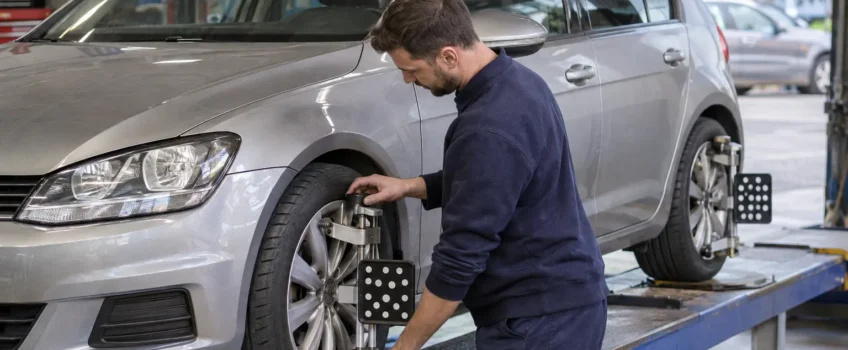
The answer depends on the car’s suspension design, manufacturer specifications and measured wheel angles. When comparing 2-wheel vs 4-wheel alignment, there is a useful distinction: measuring all four wheels does not necessarily mean adjusting all four. Rear-wheel measurements can matter even when only the front settings can be changed.
At Elite Garages, we offer both two-wheel and four-wheel alignment, allowing our technicians to recommend an appropriate approach for the vehicle and the findings of its assessment.
What is Actually Being Adjusted During Wheel Alignment?
Alignment concerns the angles at which the wheels sit and point. Three terms help explain the measurements:
- Toe describes whether the wheels point slightly inwards or outwards when viewed from above.
- Camber is a wheel’s inward or outward tilt when viewed from the front.
- Caster describes the forward or backward inclination of the steering axis when viewed from the side.
The correct settings come from the manufacturer’s specifications. Wheels are not simply adjusted until everything looks straight and not every angle is adjustable on every car.
“Wheel tracking” commonly refers to front-wheel toe adjustment. When booking, it is useful to ask which measurements and adjustments the service includes.
Why Might Only the Front Wheels Need Adjusting?
Some cars have limited routine adjustment at the rear. If the rear geometry is within specification and the front toe needs correcting, the physical adjustment may be confined to the front wheels.
For example, a small hatchback might need its front toe reset after steering work while its rear measurements remain satisfactory. That does not make the job incomplete.
However, a fixed rear axle does not make rear measurements irrelevant. If those readings are wrong, the technician needs to understand why. Vehicle age, body size or whether the car has front-wheel drive cannot, by themselves, settle which approach is appropriate.
What Does Four-Wheel Alignment Add?
Four-wheel alignment assesses how the front and rear wheels relate to one another and the vehicle’s centreline. Where rear adjustments are available and needed, they can form part of the work.
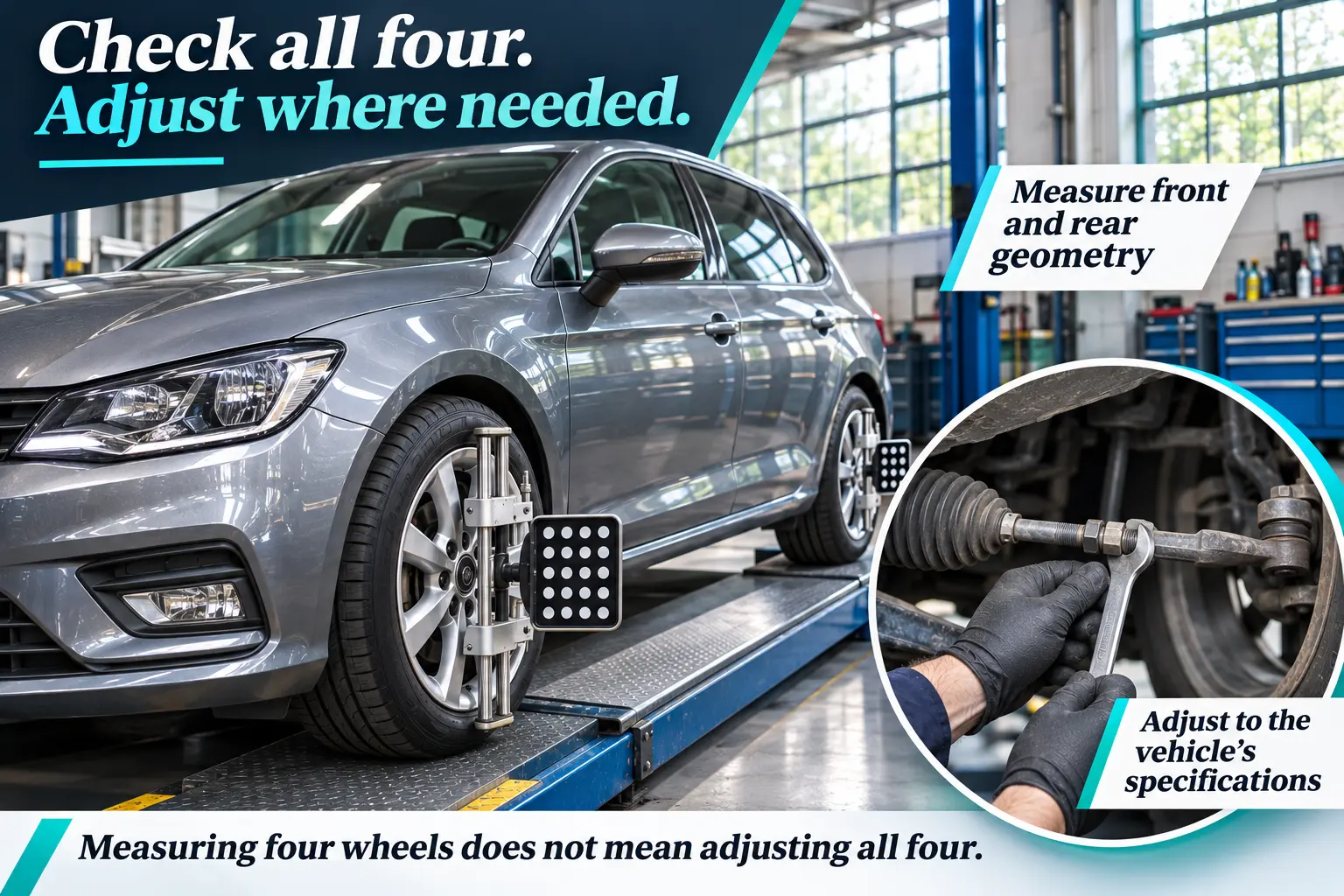
The Motor Ombudsman’s wheel alignment guide explains that computerised equipment measures wheel position and orientation, comparing the results with manufacturer alignment data.
Four-wheel alignment does not promise that every angle can be adjusted. A measurement outside specification may reveal a problem requiring further investigation.
Can the Rear Wheels Affect How the Car Drives?
Yes. The rear wheels influence the direction in which the vehicle travels. Their combined direction is described by the thrust line; its relationship to the vehicle’s centreline gives the thrust angle.
If that relationship is incorrect, it can affect steering-wheel position or make the car travel slightly off-axis. Where normal adjustment cannot resolve the readings, wear, damage or axle position may need investigating.
What Does a Technician Check Before Recommending Alignment?
A useful assessment starts with the exact vehicle and its specifications, alongside what the driver has noticed. Has the steering wheel become off-centre? Did the change follow a pothole impact or suspension repair?
Tyre pressures, condition and wear patterns also matter. Uneven wear provides a clue but it does not establish the cause on its own.
The technician then checks relevant steering and suspension components for wear or damage and considers the alignment measurements against the available adjustments.
This is why an assessment of your car’s wheel alignment should lead the recommendation. Two cars with similar tyre wear could need different work: one may require adjustment, while the other has a worn component that must be repaired first.
Why Do Track Rod Ends Matter to Wheel Alignment?
Track rods and track rod ends connect the steering mechanism to the front wheels. Adjusting the effective length of the track rod assembly changes front-wheel toe.
When a track rod end develops excessive play, wheel position can change under load. Setting the geometry while that movement remains will not provide a reliable result. The worn part needs attention before final alignment.
Should Alignment Be Checked After Track Rod End Replacement?
Yes. Replacing or disturbing a track rod end can alter the toe setting, so alignment should be checked afterwards and corrected as required.
Counting the turns when removing the old part may help establish an approximate starting position but it does not confirm that the new setting meets the manufacturer’s specification.
Our guide to track rod ends and how to recognise wear explains their function and symptoms in more detail.
Can Alignment Be Wrong Even If the Car Drives Straight?
A car does not have to pull noticeably for its alignment to be outside specification. You might first notice uneven tyre wear or a steering wheel that sits slightly off-centre.
Equally, pulling is not proof that alignment is the cause. Tyre pressures, tyre characteristics and other faults can affect how the car behaves. Driving observations help guide an inspection; measurements establish whether the geometry needs correcting.
When Is It Worth Having Alignment Checked?
Useful reasons to arrange a check include:
- Replacing track rod ends or completing relevant suspension work.
- Hitting a substantial pothole or kerb.
- Noticing unusual or uneven tyre wear.
- Finding that steering position or vehicle behaviour has changed.
- Fitting replacement tyres after the previous set wore unevenly.
For instance, if an old tyre has worn heavily along one shoulder, fitting a replacement without investigating the cause could leave the new tyre exposed to the same problem. If you are planning to reserve replacement tyres, mention any uneven wear when arranging fitting so the cause can be assessed.
New tyres alone do not mean every car needs four-wheel adjustment.
Getting the Right Alignment for Your Car
Ask the garage which measurements need correcting, what can be adjusted and whether any worn parts need attention first. Those answers should explain the recommendation.
Elite Garages serves drivers across the South and South West of England. To book wheel alignment, contact your nearest Elite Garages branch and discuss the appropriate service for your car.
FAQS
Click the + to read any answer or visit our most FAQ page to review the most frequently asked questions across all our Elite Locations.
If you click on a ‘Category’ or ‘Tag’ link, the page will ‘refresh’ and reload the page showing the top of the page first, you’ll then just need to scroll down to the FAQ section to see the results for the Category or Tag you selected.
Category:
Wheel Alignment Advice
A check is particularly useful if the old tyres wore unevenly, steering behaviour has changed or relevant repairs have been carried out. The findings determine whether adjustment is needed.
Category:
Wheel Alignment Advice
Yes. An absence of pulling does not confirm correct geometry. Measurements can identify issues that are not obvious during everyday driving.
Category:
Wheel Alignment Advice
Have it checked afterwards because replacement can change front-wheel toe. Adjustments should follow the manufacturer’s specifications.
Category:
Wheel Alignment Advice
Yes. Excessive play can allow wheel position to change, preventing reliable alignment. Worn components should be addressed before final adjustment.
Category:
Wheel Alignment Advice
Four-wheel measurement gives a broader picture of vehicle geometry. The adjustments required depend on the car’s design, manufacturer specifications and readings; adjusting more wheels is not automatically necessary.
Category:
Wheel Alignment Advice
Yes, it is possible to perform a two-wheel alignment, also known as a front-end alignment where technicians perform the service on only the front wheels. This may include a camber, toe, and caster adjustment.
Category:
Wheel Alignment Advice
Yes, it is recommended to get a four-wheel alignment when you fit new tyres. Even brand new tyres can be affected by improper wheel alignment, which can lead to uneven tyre wear, increased fuel consumption and poor handling.
Category:
Wheel Alignment Advice
To determine whether you need a two-wheel or four-wheel alignment service, you first need to consider your type of vehicle and the symptoms you are experiencing. If you need assistance, please contact your nearest Elite Garages branch for more information or you can book your wheel alignment online!
Category:
Wheel Alignment Advice
Put simply, two-wheel alignment is a procedure that corrects the positioning of your front wheels, while four-wheel alignment adjusts all four. Generally speaking, it’s not necessary to perform the latter on large SUVs or trucks with solid rear axles unless an accident has occurred and caused misalignment in its frame which translates into “dog tracking”.


