




The Safety Features You Use Every Day Without Realising It
You pull away from a junction, follow a bend and slow down behind traffic. Nothing unusual happens, yet your car may have been watching wheel speeds, steering movements and tyre pressure throughout the journey.
Modern car safety features do more than respond when something goes wrong. Many monitor the vehicle quietly, ready to intervene if braking, acceleration or stability starts to become a problem.
Understanding what these systems do makes those moments less mysterious. It also reveals something easily overlooked: even the cleverest technology still depends on the condition of the car beneath it.
ABS – When Braking Hard Isn’t Enough
During heavy braking, a wheel can lock and slide rather than keep rolling. That makes it harder to steer the car where you want it to go.
The anti-lock braking system, usually called ABS, monitors wheel speeds and rapidly adjusts braking pressure to help prevent locking. Its important contribution is helping you retain steering control during hard braking.
When ABS operates, you may feel rapid pulsing through the brake pedal and hear mechanical noise. During an emergency stop, this can be normal.
Keep firm pressure on the brake pedal rather than pumping it, and follow your vehicle handbook. The Highway Code also makes clear that ABS does not guarantee a shorter stopping distance.
There is an important difference between ABS working during an emergency and a pedal that regularly judders during ordinary braking. The latter deserves investigation rather than being dismissed as a safety feature doing its job.
Electronic Stability Control – Correcting a Problem Early
Electronic stability control, or ESC, compares your steering input with the car’s actual movement. In everyday language, it checks whether the car is going roughly where you are asking it to go.
If it detects the vehicle starting to skid or slide away from that intended path, it can brake individual wheels and reduce engine power to help restore stability.
You might see a flashing stability-control symbol, feel the car hesitate or notice a brief braking intervention. Alternatively, the correction may be subtle enough that you barely register it.
Manufacturers use names including ESP and VSC for stability control. These systems cannot make an unsuitable speed safe.
A flashing stability-control light often means the system is actively intervening, while a light that stays on may indicate that it has been switched off or has a fault. The meaning varies by vehicle, so check your handbook rather than guessing. If the light remains on unexpectedly, have the cause investigated.
Traction Control – Managing Grip When You Accelerate
Traction control tackles a different problem: driven wheels spinning when you accelerate.
It might activate as you pull away on a wet road, leave a slippery junction or climb an incline with limited grip. The wheels are being asked to transmit more driving force than the surface can support.
The system detects wheelspin and can reduce engine power or apply braking to a spinning wheel, depending on its design. You may feel a momentary loss of acceleration and see a flashing warning symbol.
Although traction control and ESC commonly share equipment, their purposes differ. Traction control manages wheelspin under acceleration; ESC helps manage the direction and stability of the whole vehicle.
Repeated intervention is a reason to ease your acceleration and consider the conditions, rather than press harder.
Brake Assist – Recognising an Emergency
In a sudden emergency, a driver may hit the brake pedal quickly without applying enough force to use the braking system fully.
Brake assist is designed to recognise an attempted emergency stop from factors such as how quickly and forcefully the pedal is pressed. It then boosts braking pressure to help the driver brake effectively.
It works alongside ABS, which manages the risk of wheel locking. You may experience stronger braking than expected, with ABS pulsing if it also activates.
Autonomous emergency braking, or AEB, adds a different capability. Using cameras, radar or other sensors, it may identify a potential collision, warn the driver and apply the brakes automatically.
Conventional brake assist responds to your braking input. AEB can intervene without you first pressing the pedal. Neither guarantees that every collision will be avoided.
TPMS – The Warning Light Watching Your Tyres
A tyre pressure monitoring system, or TPMS, warns when it detects significant tyre-pressure loss. Some systems measure pressure using sensors in the wheels; others infer a change through wheel-speed information.
Depending on the vehicle, you may see a warning symbol, a message or individual pressure readings.
That warning is not a complete tyre health report. TPMS does not measure tread depth or inspect the rubber for cuts, cracks, bulges and uneven wear. Nor should you assume that no warning means every pressure is exactly right.
Check pressures with an accurate gauge when the tyres are cold, using the vehicle manufacturer’s recommendations for the load you are carrying.
If a warning appears, stop somewhere safe and follow the handbook. Investigate the cause rather than simply resetting the system to clear the light.
ADAS – The Car Is Watching the Road Too
Advanced Driver Assistance Systems, generally shortened to ADAS, extend that monitoring beyond the vehicle itself.
Depending on the model and specification, you might have:
- Lane departure warning alerts you to unintended drifting, while lane keeping assistance can apply steering support.
- Adaptive cruise control adjusts speed to help maintain a selected gap from traffic ahead.
- Blind-spot monitoring warns about detected vehicles alongside you.
- Traffic-sign recognition displays recognised road signs.
- Parking sensors or collision warnings alert you to detected obstacles.
AEB also belongs within this wider group.
These features can produce beeps, dashboard messages, steering-wheel vibrations or changes in speed. Their capabilities vary considerably, and similar names do not guarantee identical performance.
Read the handbook and remain responsible for observation, steering and braking. Sensors have limitations, and assistance should never become a reason to stop watching the road.
The Clever Bit: All That Technology Still Has to Meet the Road
ABS manages braking pressure. Traction control limits wheelspin. ESC helps correct instability. AEB can detect a hazard and initiate braking.
Yet their interventions ultimately depend on the same physical connection: the tyres meeting the road.
A modern car can contain cameras, radar, sensors and computers capable of reacting rapidly. But it still travels on four tyres, with only a relatively small area of each touching the surface at any moment.
These areas are called contact patches. Through them, the car transfers the forces needed to accelerate, brake and turn.
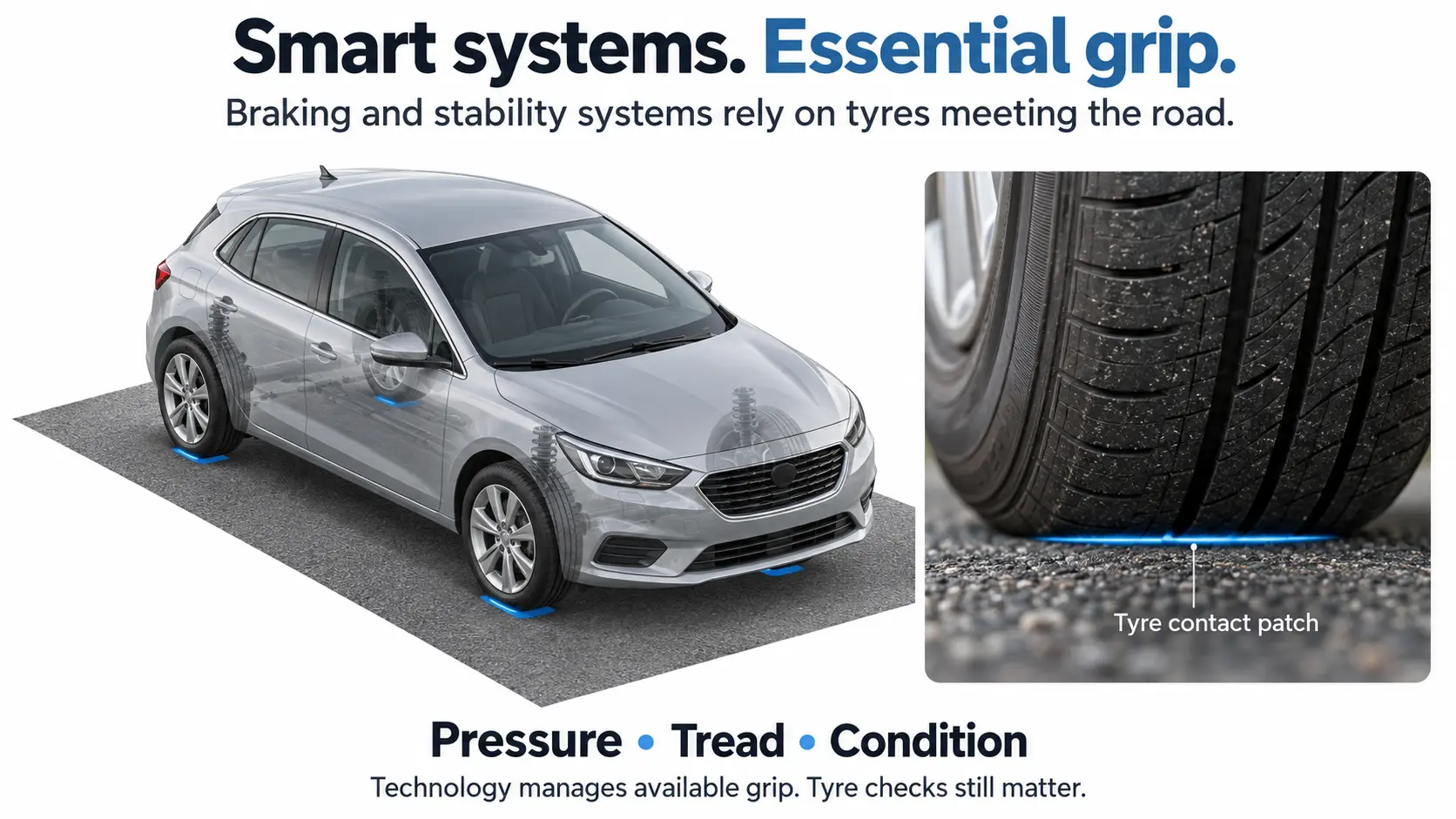
Tyre pressure affects how a tyre carries its load and behaves. Tread helps disperse water on wet roads, while damage can compromise the tyre’s integrity.
Electronics can manage the grip available. They cannot repair damaged rubber or restore missing tread.
Why This Matters During Tyre Safety Month
October Tyre Safety Month is a useful reminder that smarter cars have not removed the need for basic maintenance.
TyreSafe’s 2026 campaign, “Act Before You REact”, encourages preparation before an unexpected event puts the vehicle to the test.
An emergency is when you need tyres and technology to work together, yet tyre condition is something you can address beforehand.
Regular checks of air pressure, condition and tread remain worthwhile even when the dashboard is reassuringly clear. If you are uncertain about damage or wear, a professional tyre safety check can help establish what needs attention.
Safety Systems Don’t Replace Maintenance
The wider car matters too. Brakes must work correctly, and suspension helps control the vehicle’s movement and keep the tyres in effective contact with the road.
Changes such as pulling under braking, grinding noises or an unfamiliar pedal feel warrant attention. A brake inspection can help identify the cause.
ADAS cameras and sensors also need appropriate care. Keep their viewing areas clean as instructed, and follow manufacturer requirements for calibration after relevant repairs or windscreen replacement.
Persistent warning lights should be investigated, while regular car servicing helps keep maintenance on schedule.
Elite Garages can help with tyres, brakes, servicing, MOTs, wheel alignment and general vehicle maintenance across its branch network. Select branches also offer ADAS Calibration, including Fareham, Salisbury, and Southampton. If something feels different or you are unsure about your tyres, the team can inspect the vehicle and advise on what needs attention.
Technology provides valuable support. Looking after the car gives that support the best chance to work when you need it.
FAQS
Click the + to read any answer or visit our most FAQ page to review the most frequently asked questions across all our Elite Locations.
If you click on a ‘Category’ or ‘Tag’ link, the page will ‘refresh’ and reload the page showing the top of the page first, you’ll then just need to scroll down to the FAQ section to see the results for the Category or Tag you selected.
Category:
Car Safety Systems
No. Equipment, operating limits and warning methods vary by model, age and specification. Your vehicle handbook explains what is fitted and how it works.
Category:
Car Safety Systems
Yes. TPMS warns about detected pressure loss, but it does not check tread or inspect for damage. Regular pressure and visual checks remain necessary.
Category:
Car Safety Systems
Traction control limits driven-wheel spin during acceleration. ESC helps correct a loss of vehicle stability, using individual-wheel braking and power reduction where needed.
Category:
Car Safety Systems
It can be normal when ABS activates during hard braking. Judder during routine braking, or a new change in pedal feel, should be investigated.


