



Your Tyres Have Plenty Of Tread. So Are They Actually OK?
You look at your tyres and see plenty of tread. There is no obvious puncture, the car passed its last MOT and nothing appears immediately wrong.
Does that mean the tyres are in good condition? Not necessarily.
Tread depth is an important part of tyre safety, but it is only one part of the picture. A tyre can have usable tread while also suffering from uneven wear, incorrect pressure, cracking, impact damage or another problem that is less obvious at a glance.
Rather than relying on tread alone, it is worth looking at the whole tyre and paying attention to how the car feels on the road.
What Does Good Tread Actually Tell You?
Tread helps a tyre maintain contact with the road and disperse water from beneath it. Checking its depth is therefore important, particularly as roads become wetter.
For cars, light vans and light trailers, UK law requires a minimum tread depth of 1.6mm across the central three-quarters of the tyre and around its entire circumference. The official GOV.UK vehicle safety guidance also states that tyres must be free from cuts and defects.
That second point matters. A tyre does not become safe simply because its tread meets the legal minimum.
Tread depth tells you how much usable tread remains in the measured area. It does not tell you whether the tyre is wearing evenly, maintaining pressure or free from sidewall damage. This is why glancing only at the most visible part of the tread can provide false reassurance.
Check The Full Width Of The Tyre
Tyre wear is not always evenly distributed. The centre of the tread may look healthy while the inner or outer shoulder is considerably more worn.
Inner-edge wear can be particularly easy to miss because that part of the tyre is less visible when the car is parked. You may be able to improve your view of the front tyres by turning the steering wheel, provided the car is parked safely and the engine is switched off.
Uneven shoulder wear can sometimes be associated with incorrect pressure, wheel alignment or wear in steering and suspension components. However, the pattern alone cannot confirm the cause.
If one tyre is wearing differently from the others, or one edge is deteriorating more quickly, the relevant areas should be inspected rather than assuming that a single adjustment will solve the problem.
A wheel alignment check may be appropriate when uneven wear appears alongside pulling, an off-centre steering wheel or a recent pothole or kerb impact. The tyres, wheels and suspension may also need to be considered.
Look For Cuts, Cracks And Bulges
The sidewalls deserve as much attention as the tread.
Look around each visible sidewall for cuts, splits, cracking, embedded objects or areas that appear distorted. Where it is safe to do so, inspect both sides of the tyre rather than only the outward-facing surface.
A bulge is particularly concerning because it may indicate damage within the tyre’s internal structure. This can happen after striking a pothole, kerb or road debris, even if the tyre remains inflated.
Do not press, probe or attempt to repair a bulge yourself. Avoid continuing to drive on a tyre with serious visible damage and seek professional advice.
Fine surface marks are not always easy for a driver to interpret. If you are uncertain whether visible deterioration affects the tyre’s safety, a professional assessment is more reliable than waiting to see whether it becomes worse.
Repeated Pressure Loss Needs An Explanation
Adding air to a tyre occasionally does not automatically mean it is faulty. Pressure can change with temperature and small adjustments may be required over time.
Repeated pressure loss is different.
If one tyre regularly needs topping up while the others remain stable, there may be a puncture, leaking valve, wheel damage or another issue affecting the seal. Continually reinflating it may keep the warning light off temporarily but it does not explain why air is escaping.
Record the pressures when the tyres are cold and compare them over several days. Use the figures specified by the vehicle manufacturer rather than a pressure printed on the tyre’s sidewall. Recommended pressures are commonly found in the handbook, inside the fuel flap or on a label near the driver’s door.
A tyre that loses pressure rapidly should not be treated as something to monitor indefinitely. If it cannot maintain the correct pressure, arrange an inspection before continuing to use the vehicle normally.
Check Pressures After Carrying A Heavy Load
A vehicle carrying several passengers and a full boot may require different tyre pressures from one carrying only the driver.
Manufacturers often provide separate recommendations for normal and heavily laden driving. Before a long trip, you may therefore have increased the pressures to account for the additional load.
Once the luggage has been removed and the vehicle returns to everyday use, check the manufacturer’s guidance again. Do not assume the fully laden figures remain appropriate for normal driving.
Always check pressures when the tyres are cold. Driving warms them and naturally raises the measured pressure, so releasing air from a hot tyre to match a cold-pressure figure can leave it underinflated once it cools.
If you are unsure which figure applies, consult the vehicle handbook or ask for tyre-pressure advice rather than guessing.
New Vibration Or Road Noise Is Worth Investigating
Different road surfaces generate different amounts of noise. Coarse tarmac may create a temporary hum, while smooth asphalt can make the same tyres sound quieter.
What deserves attention is a new sound or vibration that occurs repeatedly under similar conditions.
A growing hum, drone or rhythmic noise may be connected with tyre wear, pressure or damage but wheels, bearings and other components can produce similar symptoms. A vibration through the steering wheel or seat may also involve wheel balance, wheel damage, steering or suspension.
Try to note:
- Where you feel the vibration: through the steering wheel, seat or entire car
- The speed at which it appears
- Any change during braking or turning
- Whether it started after a pothole or kerb impact
- Any visible tyre damage or unusual wear
These observations can help a technician reproduce the problem but they do not provide a reliable diagnosis on their own.
Tyres Can Age Before Their Tread Wears Out
Low-mileage vehicles do not always wear their tyres down quickly. A car used occasionally may retain plenty of tread for several years.
That does not mean the rubber remains unchanged indefinitely. Exposure to sunlight, weather, long periods of standing and general ageing can affect tyre condition.
Look for cracking, hardening or deterioration around the sidewalls and tread grooves. The age marking on the sidewall can provide useful context but age should be considered alongside condition, use and the tyre manufacturer’s guidance.
There is no single visual sign that tells a driver everything about a tyre’s remaining life. If older tyres show cracking or other deterioration, have them assessed rather than relying on tread depth alone.
Legal Does Not Always Mean Ideal
A tyre can meet the legal tread requirement and still be approaching the point at which replacement will soon be necessary.
This distinction becomes more relevant in wetter conditions. As tread reduces, the tyre has less depth available to clear water. Condition, pressure and wear pattern also influence its performance.
This does not mean every tyre above the minimum needs immediate replacement. It means the legal threshold should not be treated as the only decision point.
Consider:
- The amount of tread remaining
- How evenly the tyre is wearing
- Its ability to maintain the correct pressure
- Any cracking or impact damage
- The way the car is normally used
- The likelihood of wetter conditions or longer journeys
If replacement is appropriate, you can compare and reserve tyres online. The correct size, load rating, speed rating and suitability for the vehicle all matter, so avoid choosing a tyre on tread pattern or price alone.
Carry Out A Simple Whole-Tyre Check
You do not need specialist equipment to notice many common warning signs.
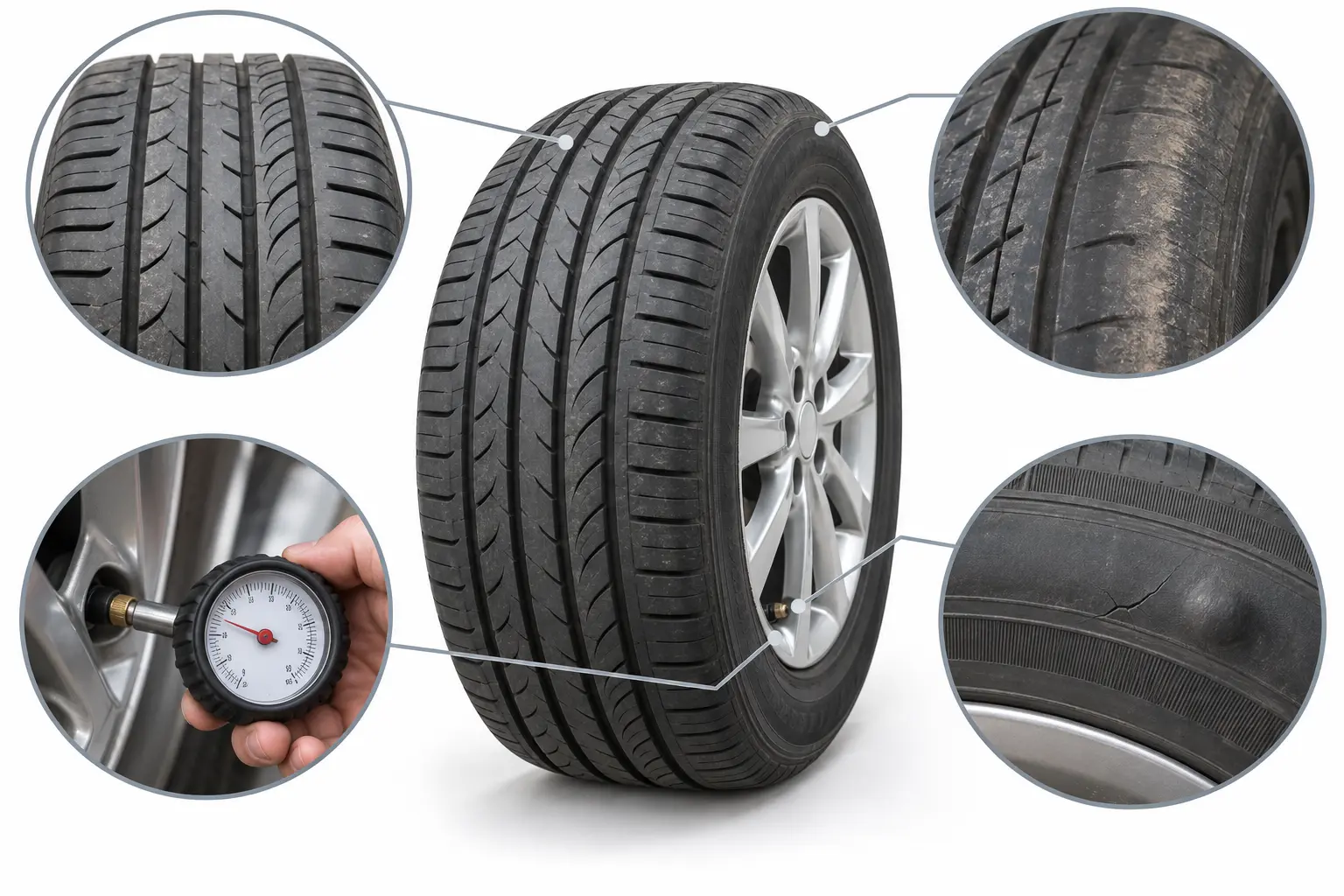
Park on level ground in a safe well-lit place. Allow the tyres to cool, then check:
- Pressure against the manufacturer’s recommendation
- Tread condition across the visible width
- Wear along the inner and outer shoulders
- Sidewalls for cuts, cracks and bulges
- Embedded objects in the tread or sidewalls
- Any tyre sitting visibly lower than the others
- Differences in wear between tyres
Do not crawl beneath an unsupported vehicle or place yourself where passing traffic could put you at risk.
An Elite Garages tyre safety check can provide a clearer assessment if you find damage, cannot see enough of the tyre or are unsure whether the wear pattern is acceptable.
Know When To Stop Driving
Arrange prompt professional advice if a tyre has a bulge, serious cut, exposed internal material, rapid pressure loss or obvious distortion.
Stop and seek assistance if the vehicle becomes unstable, a tyre suddenly deflates or severe vibration develops. Continuing to drive may worsen the damage and make the vehicle difficult to control.
Less urgent concerns, such as gradual pressure loss, mild uneven wear or a recurring new noise should still be investigated rather than left until the next MOT.
The aim is not to assume that every mark means immediate replacement. It is to recognise when tread depth alone is no longer enough to judge the tyre’s condition.
Tread Is Important But It Is Not The Whole Tyre
Plenty of tread is reassuring but it does not provide a complete assessment.
Pressure, wear pattern, sidewall condition, age and changes in how the car drives all matter. A short inspection can reveal issues that are easily missed when you look only at the centre of the tread.
If something appears unusual, Elite Garages can help establish whether the tyre remains suitable for use or whether pressure correction, repair, replacement, wheel alignment or further steering and suspension investigation is appropriate.
FAQS
Click the + to read any answer or visit our most FAQ page to review the most frequently asked questions across all our Elite Locations.
If you click on a ‘Category’ or ‘Tag’ link, the page will ‘refresh’ and reload the page showing the top of the page first, you’ll then just need to scroll down to the FAQ section to see the results for the Category or Tag you selected.
We will always try and explain this in detail, providing all the pros and cons. Put simply, budget tyres are the cheapest and often don’t last as long or hold up as well as mid-range and premium tyres. Mid-range seems to be the happy medium as they provide better grip and longevity which is only superseded by the more expensive, premium tyres that offer even better performance.


