




How to Tell When Your Car Actually Needs Servicing
Some cars make it obvious when a service is due. A message appears on the dashboard, a warning light comes on or the vehicle starts counting down the remaining miles. Others are far less helpful.
You may have to rely on the service book, an online record, a sticker tucked into the door frame or your own memory of the last garage visit. When the car starts normally and still feels fine to drive, putting the service off for another few months can seem harmless.
But cars do not always show clear symptoms when maintenance is overdue. Engine oil gradually deteriorates. Filters become restricted. Fluids age. Brakes, tyres and other components wear a little at a time, often so gradually that the driver adapts without noticing.
Knowing whether your car is due a service therefore means looking beyond how it feels today. Mileage matters, but so do time, journey type, service history and the manufacturer’s recommended schedule.
Is My Car Due a Service?
Your car may be due a service when any of the following applies:
- The dashboard service reminder has appeared
- You have reached the manufacturer’s mileage interval
- A year or more has passed since the last service
- The service history is missing or incomplete
- You have recently bought the car and do not know when it was last serviced
- The vehicle is showing changes in performance, fuel economy or how it feels to drive
The most reliable starting point is the service schedule provided by the vehicle manufacturer. Depending on the car, this may specify a fixed interval based on mileage and time, or use a flexible servicing system that considers how the vehicle has been driven.
The important point is that the absence of a warning light does not necessarily mean the car is not due.
Service reminders can be reset incorrectly, records can be incomplete and older vehicles may provide little or no dashboard guidance. When you are unsure, checking the service history or asking a garage to inspect the vehicle is usually safer than relying on guesswork.
How Often Should You Service a Car?
Many cars are serviced around every 12 months or 12,000 miles, whichever comes first. However, that is a broad guide rather than a universal rule.
Some manufacturers use shorter intervals. Others permit longer intervals when a particular oil specification or flexible servicing programme is used. Electric and hybrid vehicles also have their own maintenance schedules, even though their servicing requirements differ from conventional petrol and diesel cars.
Your owner’s manual, digital service record or manufacturer’s servicing schedule should therefore take priority over a general rule.
Elite Garages offers three servicing levels for different maintenance points: Bronze as a lubricant service and health check, Silver around 12,000 miles or 12 months, and Gold around 24,000 miles or 24 months. The right choice also depends on the vehicle’s previous servicing and manufacturer requirements.
Later in this guide, we will look more closely at how those service levels differ and which one may suit your car.
Seven Signs Your Car May Be Due a Service
A service should ideally be booked according to the recommended interval rather than postponed until something feels wrong. Even so, your car may provide clues that maintenance is overdue.
1. A service light or dashboard message has appeared
This is the clearest sign. Depending on the vehicle, the display may show a spanner symbol, a service message or a countdown measured in days or miles.
A service reminder is not necessarily warning you that something has already failed. It is usually telling you that a scheduled maintenance point has been reached.
Do not confuse it with the engine management light, oil-pressure warning or another fault indicator. Those warnings may require more immediate investigation rather than a routine service appointment.
Dashboard symbols vary between vehicles, and the colour, behaviour and type of light can affect how urgently you need to respond. Our guide to dashboard warning lights and what they mean explains the most common alerts and when it may be unsafe to keep driving.
2. You cannot remember the last service
When “sometime last year” is the most precise answer available, it is worth checking.
Look through invoices, the physical service book, the vehicle’s digital record or emails from the previous garage. Some cars also store service information within the dashboard menu.
When no reliable record exists, arranging a service gives you a known starting point for future maintenance.
3. The engine sounds or feels different
Drivers become familiar with their own cars. A new tapping, rattling or roughness at idle may be subtle, but it should not be dismissed simply because the car still moves.
Not every unfamiliar noise will be resolved through routine servicing, and some symptoms may need separate diagnostic work. However, a change in engine behaviour is a good reason to have the vehicle checked rather than waiting for the next scheduled visit.
4. Fuel economy has fallen without an obvious reason
Fuel consumption naturally changes with traffic, temperature, load and driving style. A persistent drop without a clear explanation may point to overdue maintenance or a developing fault.
Restricted filters, incorrect tyre pressures, ageing oil and various mechanical or electronic issues can all affect efficiency. A service allows key maintenance items to be checked while giving the technician an opportunity to identify anything that needs further investigation.
5. The car feels less responsive
Sluggish acceleration, hesitant starting or an engine that no longer feels as smooth as usual can have several causes.
Routine maintenance may help where the problem relates to worn service items, but pronounced hesitation, warning lights or sudden power loss should be investigated rather than treated as a normal sign of age.
6. The brakes, steering or ride feel different
A routine service includes checks that may reveal wear in safety-related components, but you should not wait for a service interval when something has clearly changed.
A soft brake pedal, pulling under braking, steering vibration, unusual knocking or reduced control needs prompt attention. These are not symptoms to tolerate until the diary is more convenient.
7. The car has an incomplete service history
A missing stamp or unexplained gap does not automatically mean the vehicle has been neglected. Paperwork gets lost, owners change garages and digital records are not always transferred clearly.
However, an uncertain history makes it harder to know whether important maintenance has been completed.
This is especially relevant after buying a used car. Starting with an appropriate service can help establish its current condition and create a clearer maintenance record from that point onwards.

Does a Low-Mileage Car Still Need Servicing?
Yes. Low mileage does not automatically remove the need for regular servicing. A car covering only a few thousand miles each year may appear to have an easy life, but the type of use matters.
Frequent short journeys can be demanding because the engine may not remain at normal operating temperature for long. Moisture and contaminants may accumulate in the oil, while the battery repeatedly supplies energy for starting without always receiving enough time to recharge fully.
Cars that remain parked for long periods can develop other issues.
- Brake discs may corrode
- Tyres can lose pressure and batteries can weaken
- Fluids and rubber components also continue to age while the odometer stands still.
This is why someone working from home, using a second car or driving mainly to local shops should not assume mileage is the only measure that counts.
Low-mileage drivers may need a different level of service from motorists covering 20,000 miles a year, but they still need a maintenance plan.
Short Journeys Can Be Harder on a Car Than They Look
Ten short journeys are not necessarily equivalent to one longer drive covering the same distance.
Each cold start places demands on the engine and battery. Until the vehicle reaches its normal operating temperature, oil does not circulate under the same conditions as it does during a fully warmed journey.
Petrol and diesel cars used predominantly for short trips may also experience issues associated with moisture, deposits and exhaust systems that do not get sufficiently hot. Diesel particulate filters can be particularly affected when the vehicle repeatedly travels short distances at low speeds, although the precise risk depends on the car and how it is driven.
That does not mean every short-trip car is heading for trouble. It does mean the servicing decision should reflect how the miles were accumulated, not just the total showing on the odometer.
Mileage or Time: Which Matters More?
Usually, both matter.
A service schedule may specify a distance and a time period, such as 12,000 miles or 12 months. In that case, the service is generally due when the first of those limits is reached.
A high-mileage driver may reach the distance threshold after eight months. A low-mileage driver may cover only 4,000 miles in a year but still reach the time limit.
This “whichever comes first” principle helps account for two different forms of deterioration:
- Mileage-related wear, caused by the vehicle being driven
- Time-related ageing, which continues even when the vehicle is used infrequently
The manufacturer’s schedule remains the final reference point because intervals vary between models, engines and drivetrains. The age of the car, its history and the conditions in which it is used may also affect what work is appropriate.
The better question is therefore not simply, “How many miles have I driven?” but rather
How long has it been, how far has the car travelled and what sort of driving has it been doing?
What If You Do Not Know the Car’s Service History?
An incomplete service history is common, especially with used cars.
The previous owner may have misplaced invoices, used several garages or relied on a digital service record that was not transferred clearly. In some cases, there may be long gaps with no reliable evidence of what was done.
That uncertainty makes it difficult to know whether routine items were completed at the correct time. The safest approach is not to assume the worst, but to establish a new maintenance baseline.
A garage can review the vehicle’s age, mileage, visible condition and any records that are available. From there, it can recommend an appropriate level of service and identify any items that may need separate investigation.
This can be particularly useful when:
- You have recently bought the car
- The service book contains missing stamps
- The dashboard reminder has been reset but there is no supporting invoice
- You do not know when the oil, filters or fluids were last changed
- The vehicle has been off the road for an extended period
- You are planning to keep the car for several years
A fresh service does not recreate the missing history, but it gives you a clear point from which to manage the car properly.
Bronze, Silver or Gold: Which Car Service Do You Need?
Once you know the car is due a service, the next question is usually which one to choose.
Elite Garages offers three service levels: Bronze, Silver and Gold. Each is designed for a different point in the vehicle’s maintenance cycle. The correct option depends on the car’s mileage, age, previous servicing, manufacturer schedule and how it is used.
Bronze Service
A Bronze Service is a lubricant service and health check.
It is generally suited to vehicles that need essential maintenance between more comprehensive services. It may also be appropriate where the car has covered relatively low mileage but still requires fresh engine oil and routine checks.
This can suit drivers who:
- Are between annual or major services
- Have covered fewer miles since the last comprehensive service
- Want key areas checked before a long journey
- Need an oil and filter change alongside a general health check
A Bronze Service should not automatically replace a fuller service when the manufacturer schedule calls for one.
Silver Service
A Silver Service is a more comprehensive option, typically associated with the 12-month or 12,000-mile point.
It includes a broader range of checks and maintenance items than the Bronze package, making it suitable for many drivers as their regular annual service.
This may be appropriate when:
- Around a year has passed since the previous service
- The car has covered approximately 12,000 miles
- The vehicle is used regularly for commuting or family travel
- A fuller inspection is due
- The service history indicates an annual service is required
For many drivers, the Silver Service will be the natural middle ground between an interim oil service and a major service.
Gold Service
A Gold Service is Elite’s most comprehensive service level and is generally associated with the 24-month or 24,000-mile point. It is intended for vehicles requiring a more extensive inspection and maintenance programme.
A Gold Service may be the most appropriate choice when:
- The car is due a major service
- Around two years have passed since the previous major service
- The vehicle has covered significant mileage
- The service record is incomplete
- You have recently bought a used car and want a thorough starting point
- Several maintenance items are due at the same time
The Gold package does not override manufacturer-specific requirements. Some vehicles may need additional items at particular ages or mileages, such as brake fluid, spark plugs, transmission oil or cambelt work.
You can compare Elite’s Bronze, Silver and Gold car servicing options before deciding which level best suits your vehicle.
Which Service Should You Choose If You Are Unsure?
When you cannot tell whether Bronze, Silver or Gold is right, consider four questions:
- When was the car last serviced?
- How many miles has it covered since then?
- What does the manufacturer recommend at this age and mileage?
- What kind of driving has the car been doing?
A low-mileage car that received a comprehensive service recently may need less work than a high-mileage commuter with an uncertain history. Equally, a car that has covered very few miles but has not been serviced for two years should not automatically be treated as maintenance-free.
The garage can help interpret the available information. That is often better than choosing solely by price or booking the most comprehensive option “just in case”.
Does Passing an MOT Mean the Car Does Not Need a Service?
No. An MOT and a service serve different purposes.
An MOT is a legal roadworthiness test. It checks whether the vehicle meets the minimum safety and environmental standards required on the day of the test.
A service is preventative maintenance. It focuses on the condition of fluids, filters and other serviceable components, while helping identify wear before it becomes a larger problem.
A car can pass its MOT and still be overdue a service.
For example, an MOT does not ordinarily involve replacing engine oil simply because it has deteriorated. Nor does an MOT confirm that every manufacturer-recommended maintenance item has been completed.
The reverse is also true. A recently serviced car can still fail its MOT if it has a defect that falls within the test, such as a damaged tyre, faulty light or excessive emissions.
Booking both at the same time may be convenient, but one does not replace the other.
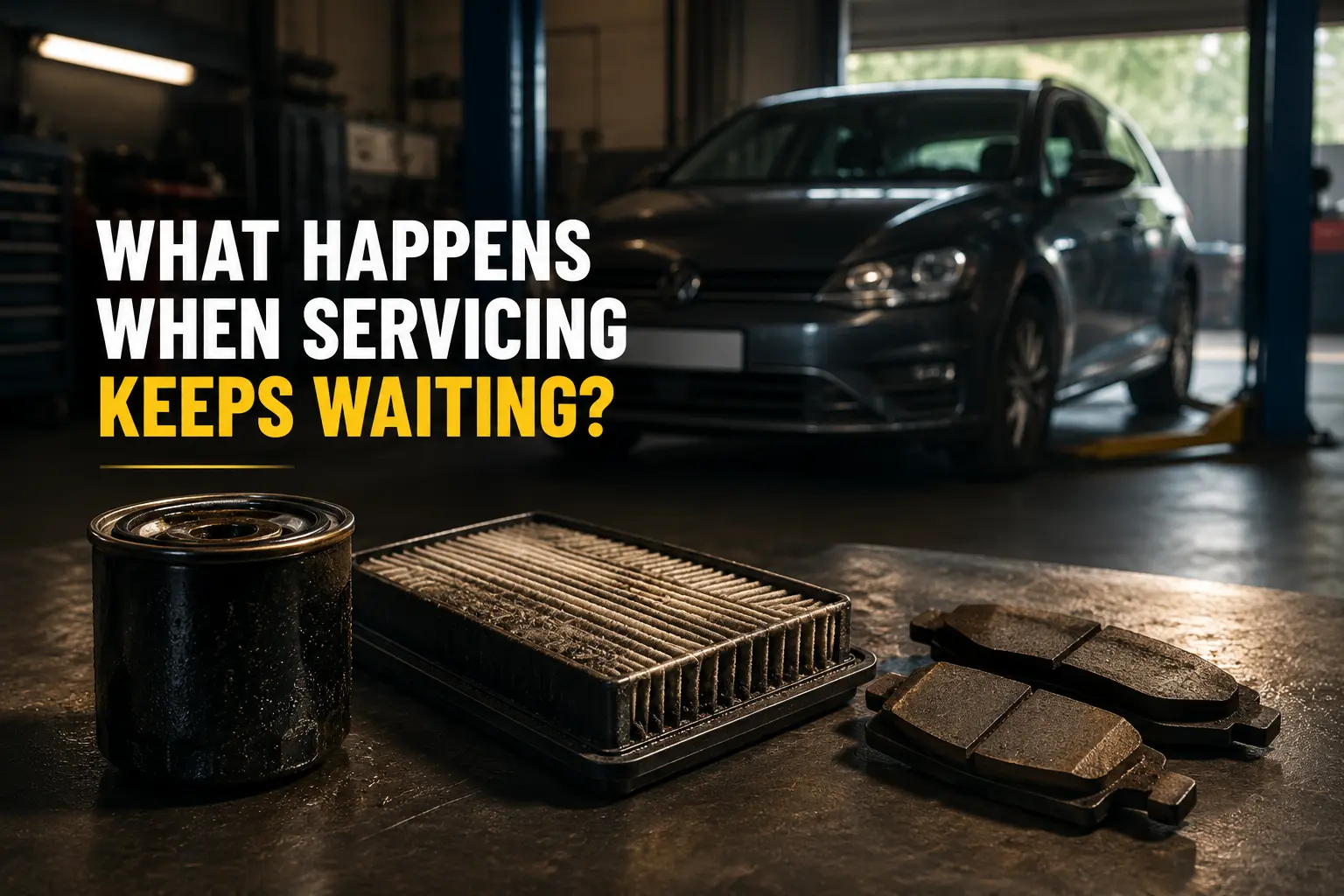
What Can Happen If You Keep Delaying a Car Service?
Missing a service by a few days is unlikely to cause an immediate breakdown. The greater risk comes from repeatedly postponing routine maintenance.
Small issues can continue developing without being noticed.
Old engine oil may provide less effective protection. Filters can become restricted. Brake wear may progress. Fluid levels or condition may deteriorate. A minor leak, damaged tyre or worn suspension component may remain undiscovered until it becomes more disruptive.
Delayed servicing can lead to:
- Reduced fuel efficiency
- Increased wear on mechanical components
- A greater risk of unexpected breakdowns
- More expensive repairs later
- Gaps in the vehicle’s service history
- Reduced confidence for a future buyer
- Potential warranty concerns where servicing requirements have not been followed
Modern vehicles can also be more expensive to repair because sensors, control modules and interconnected systems add complexity. A small problem is not guaranteed to become a large bill, but early identification gives the driver more options. Our article on why modern cars cost more to repair explains why apparently simple faults can now involve more time, parts and diagnostic work.
The purpose of servicing is not to create unnecessary work. It is to give wear and developing faults a chance to be found before they become harder to manage.
Not Every Change Means the Car Is Overdue a Service
A car that feels different needs attention, but the cause may not be routine maintenance.
Pulling to one side, steering vibration or a new suspension noise could follow a pothole impact. Uneven tyre wear may point towards wheel alignment. A warning light may indicate a specific fault that needs diagnostics rather than a standard service.
That distinction matters because a service is not a universal repair for every symptom.
If the car has recently struck a deep pothole or road defect, the damage may not be obvious immediately. Tyres, wheels, alignment, steering and suspension can all be affected. Read more about the hidden cost of pothole damage.
When booking, describe what has changed rather than simply asking for “a service”. That helps the branch understand whether the vehicle may also need a separate inspection or diagnostic check.
Can You Service a Car Before the Reminder Appears?
Yes. A service reminder is a useful prompt, but you do not have to wait until the exact day or mileage shown on the dashboard.
Servicing slightly early can be sensible when:
- You are planning a long journey
- The car will soon be difficult to take off the road
- You expect to exceed the interval during a holiday or busy period
- The vehicle has had unusually demanding use
- You are combining the service with an MOT
- You have noticed a change in the way the car performs
Early servicing is different from servicing unnecessarily often. The aim is to maintain the car at sensible intervals, not replace parts or fluids without reason.
How to Check When Your Car Was Last Serviced
Start with the simplest sources:
- Check the physical service book.
- Look through previous garage invoices.
- Search your email for booking confirmations or receipts.
- Check the vehicle’s dashboard or infotainment service menu.
- Review any manufacturer app linked to the car.
- Contact the garage that previously serviced it.
- Ask the seller or former keeper where the work was completed.
Do not rely solely on a dashboard reminder showing that no service is due. The system may have been reset without supporting evidence of the work.
Where the available records conflict, a garage can help you decide on the most sensible next step.
Do Not Wait for the Car to Feel Broken
The best time to service a car is usually before a small problem becomes an obvious one.
Dashboard reminders are useful, but they are only part of the picture. Mileage, time, driving conditions and service history all help determine when maintenance is due.
A car that feels normal may still need fresh oil, new filters or routine checks. A car that feels different may need more than a standard service. When you know when the vehicle was last maintained and how it has been used since, choosing the next step becomes much easier.
FAQs
Click the + to read any answer or visit our most FAQ page to review the most frequently asked questions across all our Elite Locations.
If you click on a ‘Category’ or ‘Tag’ link, the page will ‘refresh’ and reload the page showing the top of the page first, you’ll then just need to scroll down to the FAQ section to see the results for the Category or Tag you selected.
Category:
Service Intervals
Check the dashboard reminder, service book, digital record, previous invoices and manufacturer schedule. If none of these gives a clear answer, ask a garage to review the vehicle’s history and mileage.
Category:
Service Intervals
Bronze is a lubricant service and health check. Silver is typically suited to the 12-month or 12,000-mile point. Gold is the more comprehensive option, generally associated with 24 months or 24,000 miles. Vehicle history and manufacturer requirements should also guide the choice.
Category:
Service Intervals
Not automatically. An MOT and a service are separate. They can often be booked together, but the MOT does not replace routine servicing.
Category:
Service Intervals
It can help where poor efficiency is linked to items such as ageing oil, restricted filters or incorrect tyre pressures. However, reduced fuel economy can have many causes and may require further investigation.


