



Used Car Checks That Aren’t as Simple as They Look
Buying a used car can feel like a test of your mechanical knowledge. You check the tyres, look through the service history, take it for a drive and listen for anything that sounds unusual. If everything seems fine, what else is there to worry about?
Quite a lot, potentially.
Recent AA/Yonder research found that while 90% of motorists would take a used car for a test drive and 81% would check its service history, only 35% felt confident assessing a used car themselves. That’s an important distinction. Most drivers know they should carry out used car checks, but recognising what those checks are actually telling you is another matter.
You don’t need to be a mechanic to buy a good used car. You do, however, need to know where a seemingly reassuring check can give you false confidence.
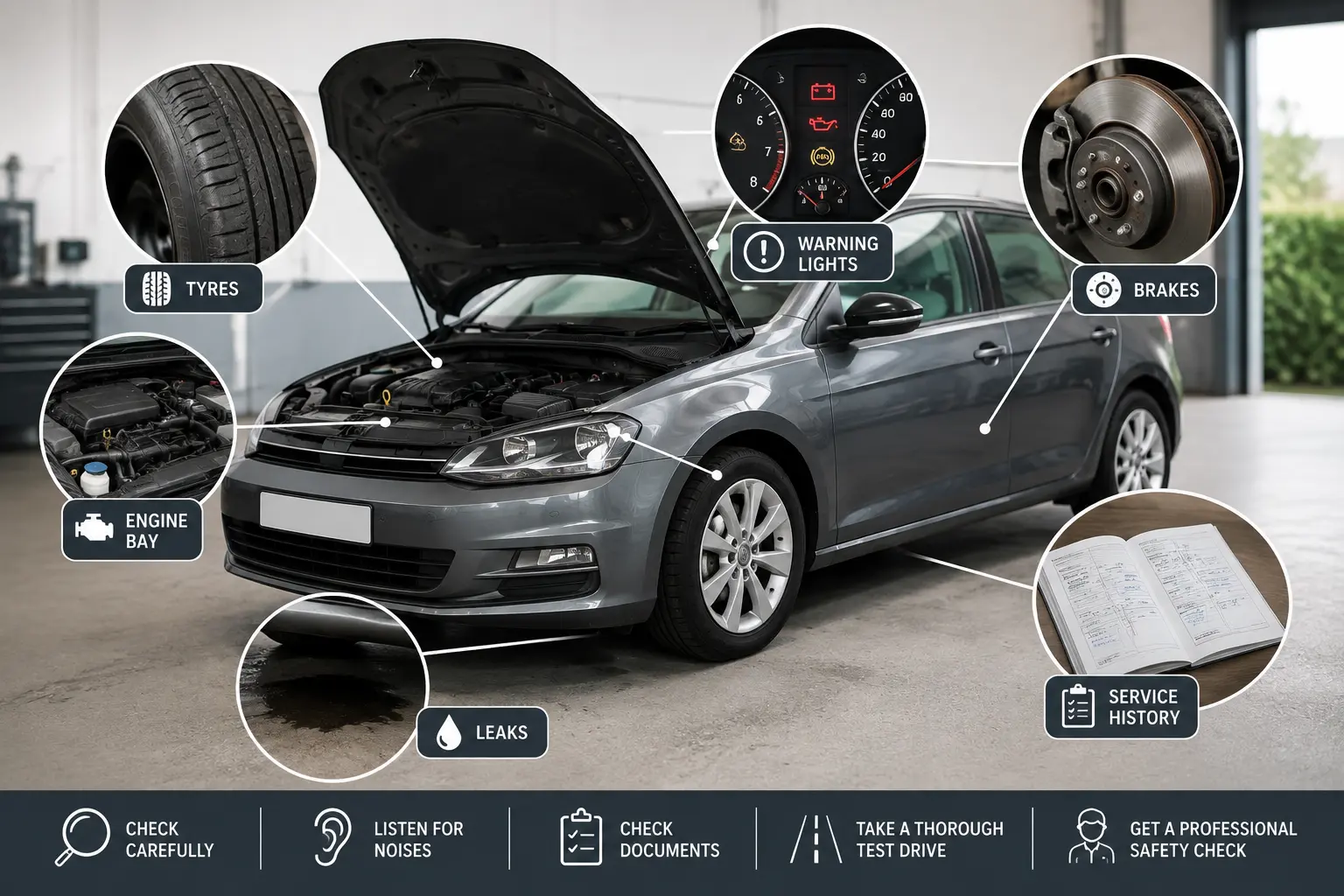
1. Checking the tyres means more than looking at the tread
Tyres are one of the easiest things to inspect when viewing a used car, which can make them easy to underestimate.
Most buyers know that tyres need sufficient tread. In the AA/Yonder survey, 60% of motorists said they would check tyres for cuts and bulges before buying. But don’t stop there.
Look across the whole visible width of each tyre. If one edge is considerably more worn than the other, there may be an alignment or suspension issue worth investigating. Look for cracking, bulges, cuts and other damage, and compare the tyres fitted across the vehicle.
Uneven wear can sometimes tell you as much about the car as the amount of tread remaining. Also consider what you’ll need to spend shortly after buying it. A car with four tyres approaching the end of their usable life might drive perfectly well during a ten-minute test drive, but replacing them soon afterwards is still a cost you should factor into your decision.
If replacement is needed, Elite Garages offers a wide range of tyre brands across economy, mid-range and premium options.
2. A full service history deserves a closer look
“Full service history” is one of those phrases that instantly makes a used car sound reassuring. It certainly can be a positive sign, but don’t treat the phrase itself as proof that everything has been maintained perfectly.
Look at the actual dates and mileages.
- Are the intervals reasonably consistent?
- Are there invoices showing what work was carried out, or simply stamps in a service book?
- Does the history suddenly disappear for several years?
Depending on the vehicle, there may also be maintenance items that aren’t obvious from a basic service stamp. Components and fluids can have their own age or mileage intervals, so it’s worth finding out what should have been done for that particular make, model and engine.
A well-organised folder of invoices can be extremely useful because it tells a story. You may be able to see not only when the car was serviced, but when tyres, brakes, batteries and other components were replaced.
If the history is patchy, that doesn’t automatically mean you should walk away. It does mean you have less evidence about how the vehicle has been maintained. Once you’ve bought a car with uncertain history, bringing its car servicing up to date can help establish a much clearer maintenance baseline.
3. Used car checks shouldn’t stop because it has a fresh MOT
A long MOT can be reassuring when buying a used vehicle, but an MOT pass should not be confused with a clean bill of mechanical health for the next 12 months. Check the vehicle’s previous MOT history as well as its current status.
Patterns can be revealing. Has the same advisory appeared several years running? Has tyre wear repeatedly been mentioned? Are there mileage records that don’t make sense?
Also pay attention to advisories on the most recent test. They aren’t necessarily reasons to reject the car, but they can point towards maintenance costs that may be heading your way.
A used car can have a valid MOT and still have components that are worn, deteriorating or likely to require attention in the foreseeable future.
4. Don’t just listen for a noise. Notice when it happens
“Listen for strange noises” is common used-car advice. The problem is that cars make plenty of noises, and without experience it isn’t always obvious which ones matter. Instead of simply deciding whether the car sounds noisy, pay attention to when the sound occurs.
Does it knock when travelling over bumps? Is there a clicking sound while turning? Do you hear a squeal when braking? Is there a vibration at a particular road speed? Does something sound different when the engine is cold?
The circumstances surrounding a noise can be useful information.
And don’t let the radio provide the soundtrack for the entire test drive. Spend at least part of the journey with it switched off and listen to the car.
5. “The brakes work” isn’t much of a brake check
A car stopping when you press the brake pedal is obviously essential, but it doesn’t tell you everything about the condition of the braking system. During a safe test drive, notice how the brakes feel.
Does the car stop smoothly and predictably? Can you feel vibration through the brake pedal? Does the steering wheel shake? Does the vehicle pull noticeably to one side?
Listen too. Persistent grinding or unusual noises deserve further investigation.
You may be able to see part of the brake disc through the wheel, but judging the remaining condition of brake components isn’t always straightforward from the pavement. If you’re unsure, don’t pretend that a quick visual inspection has told you more than it really has.
6. Warning lights should come on before they go off
When you switch the ignition on, several dashboard warning lights will normally illuminate briefly as the vehicle carries out its checks. Many should then extinguish after the engine starts. That’s worth watching.
A warning light that remains illuminated may indicate a fault. Equally, if an expected warning lamp never appears at all during start-up, it’s reasonable to ask why.
Modern cars can also store faults that aren’t obvious during a short test drive, and a dashboard without warning lights isn’t proof that every electronic or mechanical system is fault-free.
Pay attention to messages on the driver’s display too. Don’t accept “it always does that” as a technical explanation.
7. Look underneath, not just under the bonnet
Opening the bonnet feels like one of the classic used car checks. But unless you know what you’re looking at, staring at an engine for 30 seconds may not reveal very much. You can still make some useful observations.
Look around the engine bay for obvious leaks, damaged components or signs that something has recently been disturbed. Check that visible fluid levels aren’t obviously low, where they can be checked safely and correctly. Then look at the ground underneath the vehicle.
Fresh patches or drips deserve attention. Air-conditioning systems can produce harmless water condensation, so a wet patch isn’t automatically evidence of a serious leak, but oily or coloured fluid shouldn’t simply be ignored.
And use your nose. Strong burning, fuel or unusual chemical smells can be another reason to investigate further.
8. A test drive isn’t just about whether you like driving it
The AA/Yonder research found that 90% of drivers would take a used car for a test drive, making it the most common check buyers said they would perform.
That’s sensible, but the value of the test drive depends on what you’re paying attention to.
Try the car at different appropriate speeds and on different types of road where possible. Notice how the steering behaves, how smoothly the gears change, how the clutch feels on a manual car and whether the vehicle tracks straight.
Pay attention when pulling away, accelerating, slowing down and travelling over uneven surfaces. Then test the less exciting things.
- Do the windows work?
- Does the air conditioning become cold?
- Do the heater and fan operate properly?
- Are the mirrors, central locking, infotainment and parking sensors working?
One faulty convenience feature might not stop you buying an otherwise good car. Finding five of them, however, might change how you judge its condition or how well it has been looked after.
9. Check the car before you fall in love with it
This isn’t a mechanical check, but it may be one of the most useful.
It’s remarkably easy to become less objective once you’ve decided you want a particular car.
You like the colour. It’s the specification you’ve been searching for. The interior is spotless. The price is within budget. Suddenly that little suspension knock doesn’t sound quite so important.
Try to separate the two decisions:
- Do I want this model of car?
and… - Is this particular example a good one to buy?
Give yourself time to look through the vehicle properly. Don’t let excitement, a seller or the thought of another buyer rushing in persuade you to overlook something you’d normally question.
If a fault bothers you during the viewing, it will probably bother you even more once the car belongs to you.
10. Know when a used car check has reached its limits
There is plenty an ordinary motorist can sensibly check before buying a car. There are also things that are difficult to assess without experience, equipment or access underneath the vehicle. That’s normal.
The purpose of carrying out used car checks isn’t to diagnose every possible mechanical fault yourself. It’s to spot warning signs, ask better questions and recognise when you don’t have enough information to make a comfortable decision.
The AA’s 2026 polling illustrates the gap nicely: although large majorities of motorists said they would test drive a vehicle and examine its history, just over a third felt confident assessing a used car themselves.
For a useful independent checklist before viewing a vehicle, the AA’s vehicle inspection checklist covers areas including the engine, brakes, tyres, steering, suspension, bodywork, interior and electrics.
Already bought the car?
Give yourself a known starting point. Sometimes the questions start after you’ve collected the keys.
Perhaps the car drives well but its service records are incomplete. Maybe the seller told you the tyres were fine, but you’re not sure how much life they actually have left. Or you simply want to know where you stand before putting thousands of miles on an unfamiliar vehicle.
This is where a post-purchase check can be useful.
Elite Garages offers a free vehicle safety check, giving you an opportunity to have key safety-related areas checked and identify anything that may need attention.
It’s particularly worthwhile if you’ve bought a car with gaps in its maintenance history. Establishing what condition it’s in now gives you a better starting point for looking after it properly in the years ahead.
The best used car check is knowing what you don’t know
A good used car doesn’t have to be perfect. Depending on its age and mileage, some wear is entirely normal. What matters is understanding what you’re buying.
A tyre with limited life remaining, an upcoming service or a minor fault may simply become part of your calculation when deciding what the vehicle is worth. Hidden problems are more troublesome because you don’t get the opportunity to budget for them or factor them into the purchase price.
- So take your time
- Check the history
- Look closely at the tyres
- Drive without the radio for a while
- Try the equipment
- Question anything that doesn’t seem right.
And if you’re not confident about something, don’t guess. Knowing when to get a second opinion is one of the most useful used car checks of all.
FAQS
Click the + to read any answer or visit our most FAQ page to review the most frequently asked questions across all our Elite Locations.
If you click on a ‘Category’ or ‘Tag’ link, the page will ‘refresh’ and reload the page showing the top of the page first, you’ll then just need to scroll down to the FAQ section to see the results for the Category or Tag you selected.
Category:
Used Car Checklist
Start with the vehicle’s history, MOT record, service records and general condition before taking it for a test drive. Check the tyres, warning lights, bodywork and visible fluid levels, then pay attention to the steering, brakes, gearbox, engine and unusual noises while driving.
Category:
Used Car Checklist
Not necessarily, but an incomplete history creates uncertainty. Consider the vehicle’s age, condition, price and what evidence of maintenance is available. If you buy it, getting servicing up to date can help establish a known maintenance starting point.
Category:
Used Car Checklist
It can be worthwhile, particularly if the maintenance history is incomplete or you’re unsure about the condition of key safety items. A safety check can help establish the vehicle’s current condition and flag areas that may need attention.
Category:
Used Car Checklist
Listen for knocks over bumps, clicking while turning, unusual engine noises, brake squeals or grinding and noises that change with road or engine speed. Rather than concentrating only on the sound itself, notice exactly when it happens and tell a technician those details if you later have it investigated.


