


Class 7 MOT or Class 4? Why Similar Vans Can Need Different Tests
Park two vans beside each other and they may look almost identical. Same manufacturer. Same body shape. Perhaps even the same badge on the back. Yet one could need a Class 7 MOT while the other requires a Class 4 MOT.
The difference is not necessarily obvious from the driver’s seat, and it is not determined simply by calling the vehicle a van. What matters is the vehicle’s official weight classification.
That small detail can be easy to overlook until you try to book the wrong type of MOT.
Class 7 MOT or Class 4: What Is the Difference?
For most conventional petrol, diesel and hybrid goods vehicles, the dividing line is the vehicle’s design gross weight.
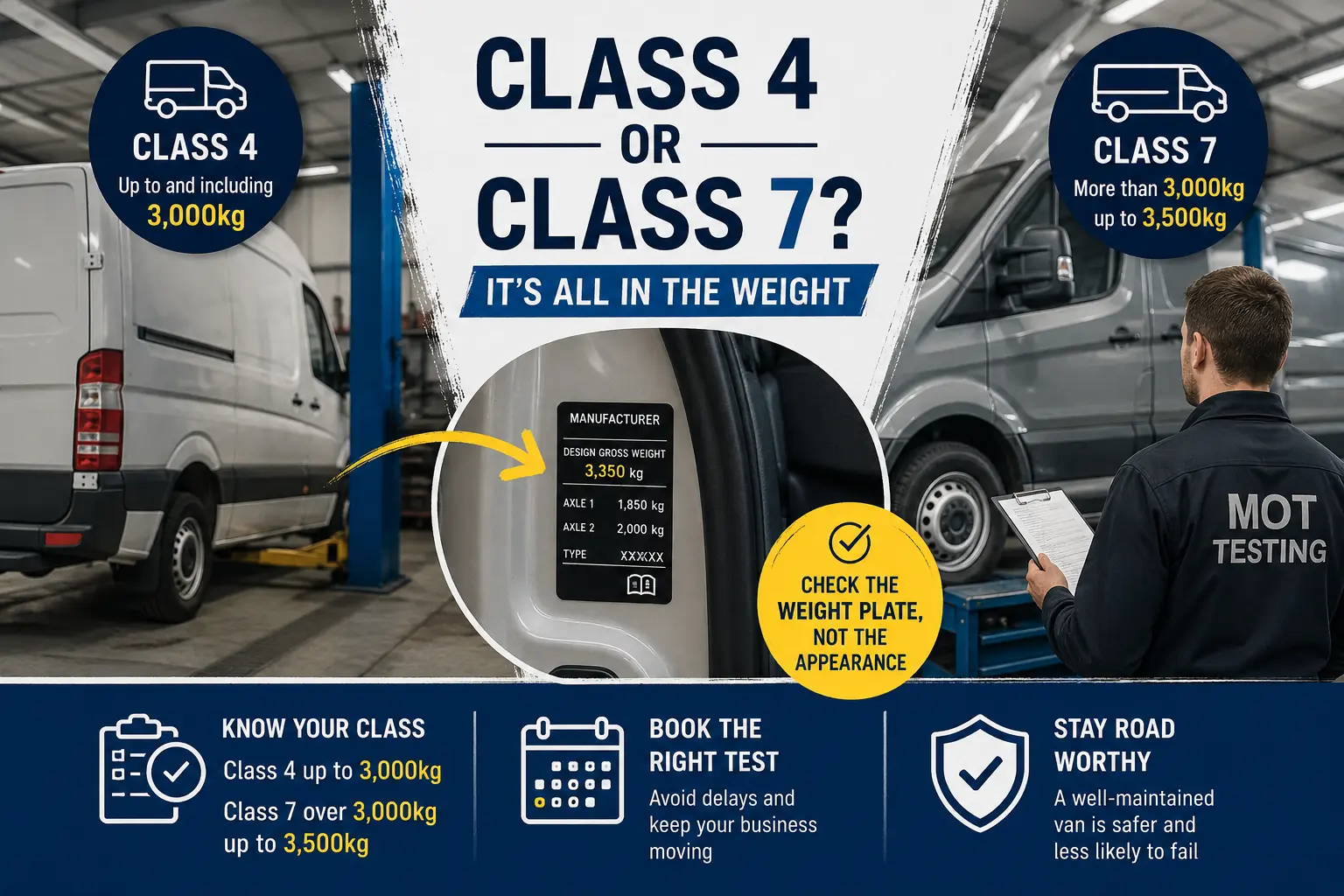
A goods vehicle with a design gross weight of up to and including 3,000kg usually falls into Class 4. A goods vehicle with a design gross weight of more than 3,000kg and up to 3,500kg requires a Class 7 MOT.
- MOT class Goods vehicle design gross weight
- Class 4 Up to and including 3,000kg
- Class 7 More than 3,000kg and up to 3,500kg
This is why relying on appearance can be misleading. Two versions of a similar van may sit on opposite sides of the 3,000kg threshold. These classifications are set out in the official GOV.UK MOT testing guide.
What Does Design Gross Weight Actually Mean?
Design gross weight is the maximum weight the vehicle is designed to carry safely, including:
- The vehicle itself
- The driver and passengers
- Tools, stock or equipment
- Fuel
- Any other load being carried
It may also be described as gross vehicle weight, GVW or maximum authorised mass, commonly shortened to MAM. Crucially, it is not the amount your van happens to weigh on MOT day.
Removing tools from the back will make the vehicle lighter, but it will not turn a Class 7 vehicle into a Class 4 vehicle. The MOT class is based on the vehicle’s official weight rating, not its current load.
Why Similar Vans Can Need Different MOT Classes
Van manufacturers frequently offer different configurations within the same model range.
There may be changes in:
- Payload capacity
- Wheelbase and body length
- Roof height
- Suspension specification
- Axle ratings
- Chassis construction
- Manufacturer-approved gross weight
From the outside, those differences may be subtle. A higher-rated model may not look dramatically larger or heavier than the version parked beside it.
Even familiar names such as panel vans, crew vans, dropsides, tippers and pickups can cover multiple specifications. The model name alone is therefore not always enough to identify the correct MOT class.
The number that matters is the official weight rating.
How Do I Know Whether My Van Needs a Class 7 MOT?
The safest approach is to check the vehicle rather than guess.
Look for the manufacturer’s plate or weight sticker. Its position varies between vehicles, but common locations include:
- Inside the driver’s door or door frame
- Under the bonnet
- Around the engine bay
- Near the fuel filler area
The plate will usually show several figures. These may include the design gross weight, combined vehicle and trailer weight, and the permitted weight for each axle.
You may also find relevant information in the owner’s handbook or vehicle documentation. When reading the plate, do not confuse the design gross weight with the axle weights or train weight. They refer to different limits.
When there is still any uncertainty, speak to the garage before booking. Providing the registration number and vehicle details gives the team a chance to confirm which test is appropriate.
Is a 3.5-Tonne Van Class 7?
In most cases, yes.
A petrol, diesel or hybrid goods vehicle with a design gross weight of 3,500kg falls within Class 7 because the category includes qualifying vehicles over 3,000kg and up to and including 3,500kg.
The phrase “3.5-tonne van” is commonly used for larger commercial vans, box vans, tippers and similar working vehicles. However, it is still worth checking the manufacturer’s plate because informal descriptions are no substitute for the official vehicle specification.
An Important Class 7 MOT Change for Electric Vans
The rules have recently changed for certain heavier zero-emission goods vehicles.
From 1 June 2026, zero-emission goods vehicles with a design gross weight between 3,501kg and 4,250kg are also treated as Class 7 vehicles for MOT purposes. Their first Class 7 MOT is normally due three years after registration.
This change recognises that electric vans may be heavier than equivalent combustion-powered vehicles because of the battery.
Owners of zero-emission commercial vehicles above 3,500kg should confirm the exact vehicle specification and check with the chosen branch before booking.
For a broader look at how MOT testing is changing, read our guide to the new MOT rules for 2026.
What Happens If You Book the Wrong MOT?
Booking a Class 4 test for a Class 7 van does not change the vehicle’s classification.
It may instead mean:
- Your booked test cannot go ahead as planned
- The appointment needs to be rearranged
- The van stays off the road for longer
- Work, deliveries or customer visits have to be moved
- Another journey to the garage is required
That is inconvenient for any driver. For a tradesperson, courier, fleet operator or small business, it may also mean lost working time. A quick weight check before booking can prevent a surprisingly disruptive mistake.
What Does a Class 7 MOT Check?
A Class 7 MOT examines whether the vehicle meets the required standards for roadworthiness, safety and emissions.
The inspection covers areas including:
- Brakes
- Steering
- Suspension
- Tyres and wheels
- Lights
- Mirrors and visibility
- Seat belts
- Windscreen and wipers
- Exhaust and emissions
- Fuel system
- Vehicle structure
- Registration plates and identification
The broad inspection areas will sound familiar to anyone who has booked a Class 4 MOT. However, the vehicle must be presented and tested under the correct class, with the relevant standards and vehicle weight information applied. The official MOT inspection manual covers Classes 3, 4, 5 and 7.
An MOT is also different from a service. It checks whether the van meets minimum legal standards at the time of the test. It does not replace routine maintenance, oil changes or manufacturer-recommended servicing.
A Five-Minute Check Before Your Class 7 MOT
You cannot inspect everything an MOT tester will examine, but a few simple checks may uncover obvious problems before the appointment.
Walk around the van and check that:
- all exterior lights are working, including brake lights, indicators and number plate lights.
- tyres have sufficient tread and show no obvious cuts, bulges or exposed cords.
- windscreen wipers clear the glass properly rather than smearing water across it.
- mirrors are secure and usable.
- number plates are clean, secure and readable.
- no warning lights remain illuminated unnecessarily after the engine starts.
- the driver’s seat belt fastens and retracts correctly.
These may sound like small details, but lights, tyres, wipers, warning lights and number plates can all cause problems at test time. Our guide to MOT failures drivers often overlook explains what to check in more detail.
For working vans, also consider what may have become easy to ignore. A gradually worsening steering pull, knocking suspension or change in braking feel deserves attention, even if you have adapted to it over time.
Where Can I Book a Class 7 MOT at Elite Garages?
Class 7 MOT testing is available at seven confirmed Elite Garages branches:
Each of these branches also offers Class 4 MOT testing.
That is useful when the vehicle’s classification is not immediately clear. You can contact the branch, explain what you drive and confirm the correct appointment before bringing the vehicle in.
You can also review the wider Elite Garages MOT service or use the branch finder for location and contact information.
Check the Plate, Not Just the Van
You do not need to become an expert in vehicle classifications to book the right MOT.
The main thing to remember is simple: the way a van looks does not necessarily tell you which MOT it needs.
Check the manufacturer’s weight plate, identify the design gross weight and confirm the MOT class before booking. It takes only a few minutes and could save a wasted appointment, an unnecessary return journey and valuable time off the road.
When you are ready, book your MOT with Elite Garages or contact one of the seven participating branches for help confirming the correct test.
FAQS:
Click the + to read any answer or visit our most FAQ page to review the most frequently asked questions across all our Elite Locations.
If you click on a ‘Category’ or ‘Tag’ link, the page will ‘refresh’ and reload the page showing the top of the page first, you’ll then just need to scroll down to the FAQ section to see the results for the Category or Tag you selected.
Category:
Class 7 MOT
No. You should confirm that the test centre offers Class 7 MOTs before booking. At Elite Garages, the seven branches listed above offer both Class 4 and Class 7 testing.
Category:
Class 7 MOT
No. The MOT class is based on the vehicle’s design gross weight, not how heavily it is loaded when it arrives for the test.
Category:
Class 7 MOT
It is not intended to be a deliberately harder test. It assesses the vehicle against the standards that apply to its class and specification. A properly maintained Class 7 vehicle should not be viewed as inherently more likely to fail.
Category:
Class 7 MOT
Yes. Similar-looking models may have different official weight ratings. One version could be rated at or below 3,000kg and fall into Class 4, while another exceeds 3,000kg and requires a Class 7 MOT.
Category:
Class 7 MOT
No. Class 7 applies to qualifying goods vehicles based primarily on vehicle type and design gross weight. This can include larger vans, pickups, tippers and other light commercial goods vehicles.
Category:
Class 7 MOT
Qualifying vans generally require their first MOT three years after registration and annually thereafter.


