




Why Is My Car Air Conditioning Blowing Warm Air?
On a hot day, there are few things more frustrating than switching on the car’s air conditioning and getting nothing but warm air from the vents.
It is easy to assume the system simply needs regassing. Sometimes it does. However, low refrigerant is only one possible cause. A leak, blocked filter, damaged condenser, electrical fault or failing compressor can all produce similar symptoms.
The way the problem behaves can offer useful clues. Does the air start cold and then turn warm? Is it cooler when the car is moving? Does the airflow feel weak, or does the system make an unfamiliar noise?
Understanding those differences can help you decide whether your car may need a straightforward air-con recharge or a more detailed inspection.
Air conditioning problems can become particularly noticeable during warmer weather, alongside other seasonal issues such as car overheating in hot weather.
Does Warm Air Always Mean the Air Con Needs Regassing?
No. A lack of refrigerant is a common reason for poor cooling, but regassing the system will not repair a damaged component or stop refrigerant escaping through a leak.
A car’s air-conditioning system works by circulating refrigerant through a closed circuit. Heat is absorbed from the cabin and released outside the vehicle. If the refrigerant charge is too low, or one of the components cannot move or cool it properly, the air coming through the vents may no longer feel cold.
A regas replaces the refrigerant and restores the correct system pressure. It may solve the problem when the rest of the system is working correctly. If there is an underlying fault, however, the improvement may be limited or short-lived.
That is why the symptoms and the system’s condition should be considered before assuming that every case of warm air needs the same solution.
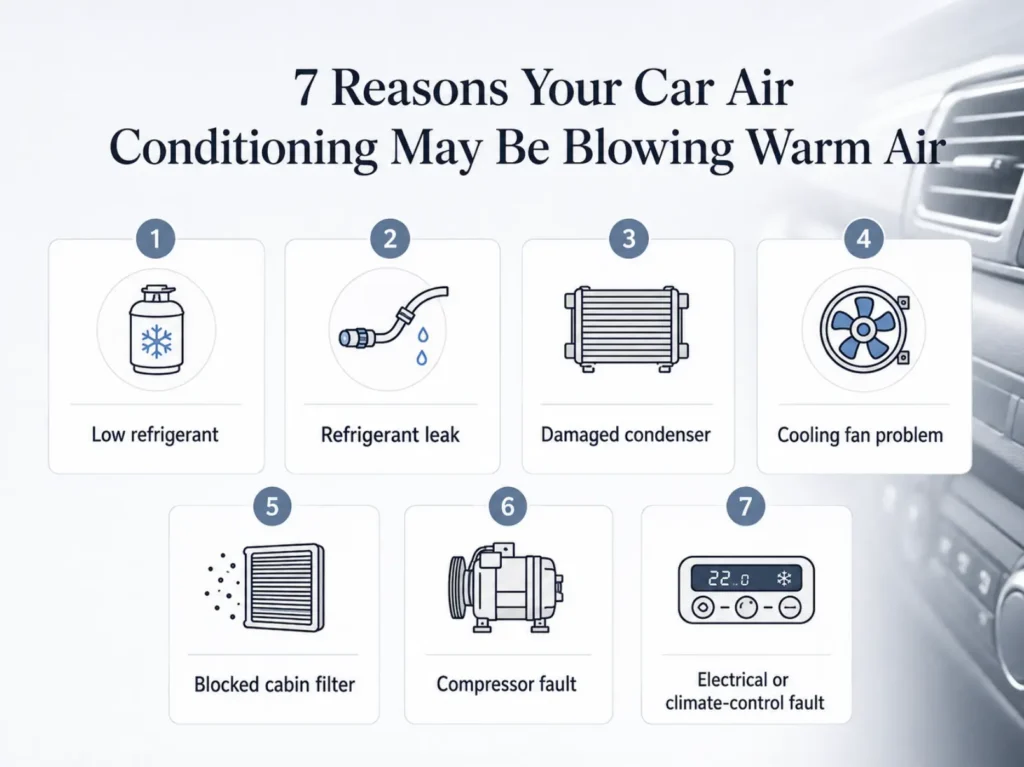
Seven Reasons Your Car Air Conditioning May Be Blowing Warm Air
1. The Refrigerant Level Is Too Low
The air-conditioning system needs the correct amount of refrigerant to absorb heat from inside the car.
When the level becomes too low, cooling performance may gradually decline. You might notice that the air is no longer as cold as it used to be, even with the temperature set to its lowest position.
This can develop slowly, making it easy to overlook until the weather becomes hot. A professional air-con service can check the system and determine whether a recharge is appropriate.
Elite Garages provides car air-conditioning servicing, recharging and repairs for a wide range of vehicles.
2. There Is a Refrigerant Leak
Low refrigerant and a leak are not quite the same problem.
A system may need recharging after its cooling performance has gradually reduced. However, if refrigerant disappears quickly, the system stops working shortly after a regas or it needs repeated recharging, there may be a leak.
Leaks can develop around seals, pipes, connections, the condenser or other parts of the system. Some are obvious during testing, while smaller leaks may require specialist equipment to locate.
Simply adding more refrigerant will not provide a lasting repair if it continues to escape. The source of the leak needs to be found and assessed first.
3. The Condenser Is Damaged or Obstructed
The condenser normally sits towards the front of the vehicle, where airflow helps it release heat carried away from the cabin.
Its position also leaves it exposed to road dirt, insects, corrosion and impact damage from stones or other debris. If airflow through the condenser is restricted, or the component is leaking, the air-conditioning system may struggle to cool the car.
A condenser problem may be more noticeable in slow traffic or while the vehicle is stationary. At higher speeds, the increased airflow through the front of the car may temporarily improve cooling.
4. The Cooling Fan Is Not Working Properly
The cooling fan helps draw air through the condenser when the vehicle is stationary or moving slowly.
If the fan is not operating correctly, the air conditioning may feel reasonably cold while driving but become noticeably warmer when you stop at traffic lights or sit in a queue.
This symptom does not prove that the fan is at fault. Refrigerant pressure, electrical issues and condenser problems can behave similarly. It is still a useful detail to mention when the system is inspected.
5. The Cabin Filter Is Blocked
The cabin filter, sometimes called the pollen filter, helps remove dust, pollen and other particles from the air entering the interior.
As it becomes clogged, airflow through the vents can weaken. The air may still be cool, but there is not enough of it moving into the cabin to lower the temperature effectively.
Possible signs of a blocked cabin filter include:
- Weak airflow, even with the fan turned up
- More noise from the fan than usual
- Slow windscreen demisting
- Dusty, stale or unpleasant smells
- Different airflow strength between vent settings
Replacing the filter may improve airflow, but it will not repair a refrigerant or compressor fault. The exact cause depends on whether the air itself is warm or simply not moving strongly enough.
6. The Compressor Is Not Operating Correctly
The compressor circulates refrigerant through the air-conditioning system. Without it, the system cannot move heat out of the cabin effectively.
Compressor problems can be mechanical or electrical. Depending on the vehicle, possible signs include warm air, intermittent cooling, unusual clicking or rattling noises, or a change in engine note when the air conditioning is switched on.
Some modern compressors do not behave in the same way as older belt-driven units, particularly on hybrid and electric vehicles. A proper diagnosis is therefore more reliable than listening for a particular noise or attempting to judge whether the compressor has engaged.
7. There Is an Electrical or Climate-Control Fault
Modern climate-control systems rely on sensors, control modules, pressure switches, relays and electrically operated air flaps.
A fault may stop the compressor from running, send an incorrect temperature reading or prevent cooled air from being directed into the cabin properly.
This can produce symptoms such as:
- Air conditioning that works intermittently
- One side of the cabin being colder than the other
- Temperature settings that make little difference
- The system switching itself off
- Cold air coming from some vents but not others
Diagnostic testing may be needed to distinguish an electrical issue from a refrigerant or mechanical fault.
Why is my car air con blowing hot air on one side?
If the air conditioning is blowing cold on one side of the car but warm on the other, the problem may lie with a temperature sensor, air-mix flap or actuator within the climate-control system. Some vehicles use separate controls for the driver and passenger sides, so a fault can affect one area of the cabin while the other continues working normally. Low refrigerant can occasionally contribute to uneven cooling, which is why proper testing is more reliable than replacing parts based on the symptom alone.
What Do Strange Air-Con Noises Mean?
Air-conditioning systems are not completely silent. You may hear the fan change speed or notice a slight alteration in engine sound when the system begins working.
- New, loud or persistent noises deserve more attention.
- A clicking noise could relate to an electrical relay, air-direction flap or compressor component.
- Rattling may come from debris around the fan or a worn mechanical part.
- Hissing can sometimes occur as pressures equalise, although persistent hissing alongside poor cooling may need investigation.
The sound alone may not identify the fault, but its location and timing can provide useful clues.
Why Is My Air Con Cold While Driving but Warm When Stationary?
Air conditioning that improves once the car begins moving often points towards an airflow or heat-dissipation problem. When the vehicle is travelling, air naturally passes through the condenser. When it stops, the system relies more heavily on the cooling fan.
A weak or failed fan, restricted condenser or pressure-related fault may therefore become more obvious in traffic. The outside temperature also matters: a system that appears acceptable on a mild day may struggle during hotter conditions.
This symptom is helpful, but it should not be treated as a diagnosis by itself.
Why Does the Air Start Cold and Then Turn Warm?
Air that begins cold but becomes warm after several minutes can have several causes.
The system may be losing pressure, the compressor may be cutting out, a sensor could be sending an incorrect reading or moisture within the system could be contributing to restricted refrigerant flow.
In some cases, the evaporator can become too cold and begin icing up. Airflow may weaken until the system is switched off and allowed to thaw.
Make a note of how long the cooling lasts and whether it returns after the vehicle has been switched off. That pattern can help a technician narrow down the fault.
My Air Conditioning Stopped Working After a Regas. What’s Wrong With The Car?
A recent regas should usually improve cooling if low refrigerant was the only issue.
If the air conditioning becomes warm again within days or weeks, there may be a leak or another fault that was not resolved by replacing the refrigerant.
Other possibilities include:
- A compressor that is not circulating refrigerant properly
- An intermittent electrical problem
- A damaged or restricted condenser
- A faulty pressure sensor
- Incorrect air-mix or climate-control operation
Repeatedly recharging a leaking system is unlikely to provide a lasting solution. It is better to investigate why the refrigerant or cooling performance has been lost.
Why Does My Car Air Conditioning Smell?
An unpleasant smell from the vents is often caused by moisture, dirt or microbial growth around the ventilation system and evaporator.
The odour may be described as damp, musty or similar to wet socks. It can be particularly noticeable when the system is first switched on.
A blocked or overdue cabin filter may contribute to the problem. Cleaning or sanitising the system can also help where bacteria and odours have built up around the vents.
A smell should not automatically be confused with a refrigerant leak. If you notice a burning smell, chemical odour or smoke, switch the system off and arrange for the vehicle to be inspected.
Is Water Dripping Under the Car After Using the Air Con Normal?
A small puddle of clear water beneath the car can be completely normal after the air conditioning has been running.
As warm, humid air passes over the cold evaporator, moisture condenses and drains underneath the vehicle. This is similar to the condensation produced by a household air-conditioning unit.
However, not every fluid beneath a car is harmless.
Coolant may be coloured and can feel slightly slippery, while engine oil is usually darker. If the liquid is not clear water, continues appearing when the air conditioning has not been used or is accompanied by overheating, warning lights or a falling fluid level, it should be checked.
Our guide to why cars can overheat in hot weather explains some of the other warning signs drivers should not ignore.
Does Air Conditioning Help Demist the Windscreen?
Yes. Air conditioning does more than cool the cabin. It also removes moisture from the air, which can help clear condensation from the inside of the windows.
That makes a functioning system useful throughout the year, not only during summer.
The Highway Code states that windows should be thoroughly demisted before setting off, and drivers should use their demisters when visibility is reduced.
If your windscreen is taking much longer than usual to clear, poor airflow, a blocked cabin filter or an air-conditioning problem could be contributing.
Can Faulty Air Conditioning Increase Fuel Consumption?
Using air conditioning places an additional load on the vehicle, so it can affect fuel or energy use. The difference depends on the car, the outside temperature, the selected settings and the type of journey.
A system that is struggling may run for longer as it tries to reach the requested cabin temperature. However, unusually high fuel consumption should not automatically be blamed on the air conditioning, as tyre pressures, driving style, short journeys and mechanical issues can all have an effect.
For a broader explanation, read why your car may use more fuel in summer.
Is an Air-Con Service Included in a Normal Car Service?
An air-conditioning recharge is generally separate from a routine car service.
Depending on the service level, a technician may check the air-conditioning system’s operation or temperature. That does not necessarily include recovering and replacing the refrigerant, leak testing or diagnosing a specific air-con fault.
This is why a car can be up to date with its regular servicing but still have poor air-conditioning performance. If you are unsure whether the rest of the car is also due attention, our guide explains the common signs that your car may be due a service.

When Should You Have Your Car Air Conditioning Checked?
Consider having the system checked when:
- The air is no longer as cold as it used to be
- Warm air continues after several minutes
- Cooling comes and goes
- The system only works properly while driving
- Airflow from the vents has weakened
- There are unfamiliar noises or smells
- The windscreen is slow to demist
- Cooling disappeared shortly after a previous regas
The sooner the underlying cause is identified, the less chance there is of paying for a recharge that does not solve the real problem.
Regas or Repair: Finding the Real Cause
Warm air from the vents does not always mean something serious has failed. The system may simply need recharging. At the same time, a regas should not be treated as a guaranteed cure for every air-conditioning problem.
The most useful approach is to consider how the system is behaving and check whether low refrigerant is the cause or the result of something else. Leaks, airflow restrictions, electrical faults and damaged components all require different solutions.
Elite Garages can inspect your car’s air-conditioning performance and explain what is needed before additional work is carried out. You can book an air-con service online at your preferred participating branch.
Related Servicing and Maintenance FAQs
Looking for more advice about keeping your car in good condition? Explore our related FAQs covering car servicing, routine maintenance and common questions from drivers.


